The Best Drum Kits for Hip Hop Production
The best hip hop drum kit isn’t a single magic folder of sounds. It’s a carefully chosen arsenal that just clicks with your style. For that classic boom bap vibe, you’re looking for dusty snares and kicks sampled from old vinyl. But for modern trap? It’s all about those deep, rumbling 808s and razor-sharp electronic percussion. At the end of the day, the right kit is the one that gives you punchy, mix-ready sounds that feel intuitive and get you making beats faster.
Decoding the DNA of Hip Hop Drums
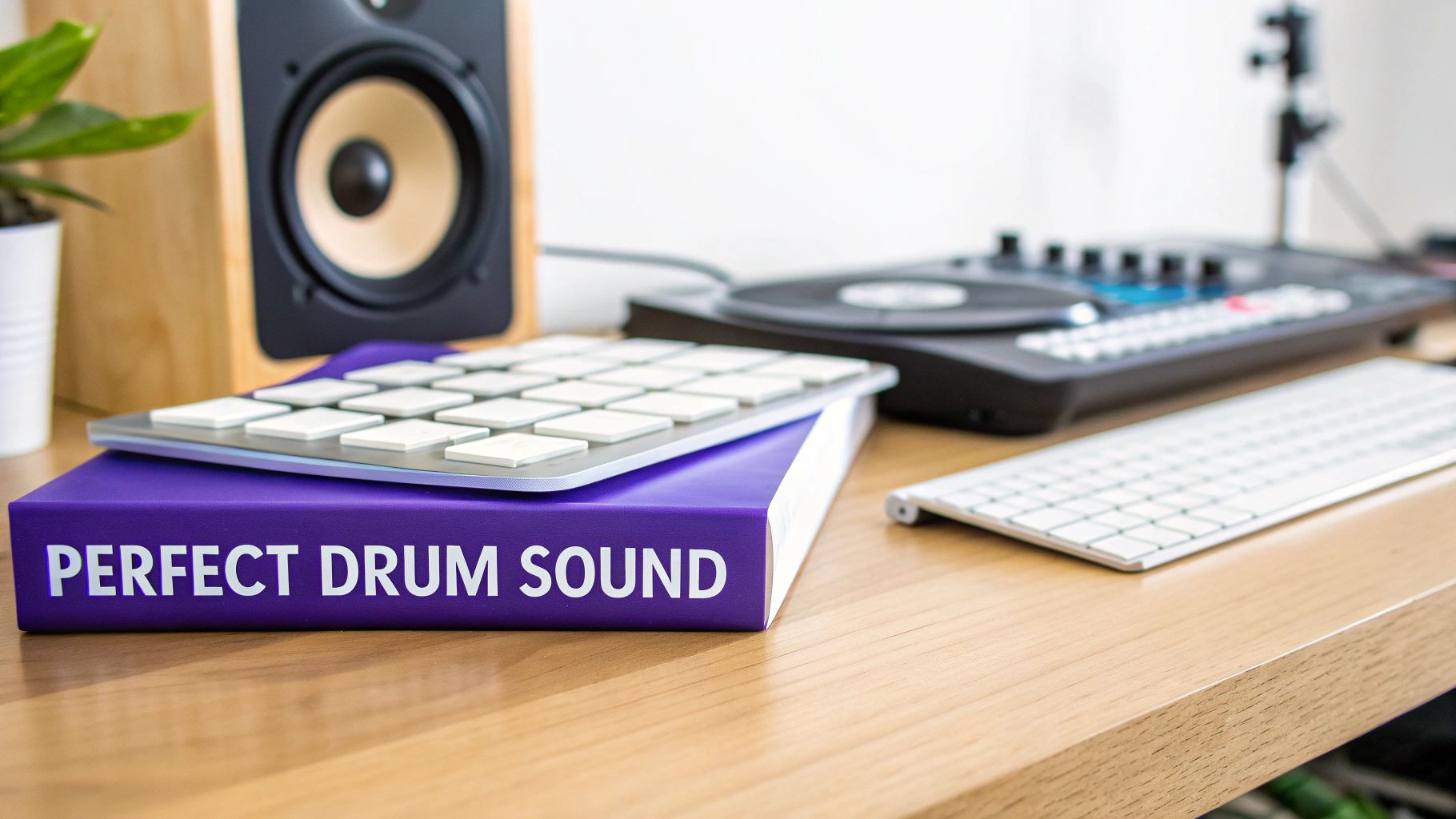
Nailing the perfect drum sound is step one in making a beat that feels authentic. Hip hop is built on rhythm—its character, its punch, its groove. It doesn’t matter if you’re chasing the laid-back swing of J Dilla or the hard-hitting energy of Metro Boomin; the drums tell the story. A kit’s personality comes from where its sounds were sourced, how they were processed, and the specific subgenre it was built for.
Back in the day, the sound was all about acoustic kits sampled from dusty funk and soul records. Now, electronic and hybrid kits are king. The global market for drum sets was valued at USD 152.39 million in 2025 and is expected to climb to USD 250.6 million by 2034. A huge part of that growth comes from electronic kits, especially in hip hop. North America makes up a massive 39.10% of that market, driven by producers in hubs like Atlanta and LA needing those perfectly tunable trap sounds.
Key Sonic Elements of a Great Kit
Before you start downloading, you need to know what to listen for. The best kits always deliver in these key areas:
- The Kick Drum: This is the heartbeat. It needs to be punchy enough to cut through the mix without turning into a muddy mess in the low end.
- The Snare: This is the backbeat, the attitude. A great hip hop snare has that signature “crack” or “thump” that gives the beat its flavor.
- Hi-Hats and Cymbals: This is where the bounce comes from. Look for a good variety—open, closed, and pedal hats—so you can program those fast, modern trap rolls or a simple, groovy pattern.
- The 808: It’s so much more than a bassline. In modern hip hop, the 808 is a core rhythmic and melodic tool. It needs to have both that deep sub-bass rumble and a clear, defined attack.
A truly great hip hop drum kit isn’t just a random collection of sounds. It’s a curated sonic palette. Every kick, snare, and hat should feel like it belongs together, creating a cohesive foundation that makes beat-making feel effortless.
Getting these fundamentals right is everything. If you want to go deeper, check out our dedicated guide on specific drum sounds for hip hop.
Quick Guide to Hip Hop Drum Kit Types
Different subgenres need different textures. The kit you choose will completely define the vibe of your track. Here’s a quick look at the main types to help you figure out what you need.
| Kit Type | Core Sound Characteristic | Best For Subgenres | Example Use Case |
|---|---|---|---|
| Boom Bap Kits | Gritty, warm, sampled from vinyl | 90s Hip Hop, Lo-Fi, Neo-Soul | Creating a dusty, off-kilter groove that sounds like something from A Tribe Called Quest. |
| Trap Kits | Clean, hard-hitting, deep 808s | Trap, Drill, Modern Hip Hop | Building an aggressive, high-energy beat with rapid hi-hat rolls and a powerful low end. |
| Lo-Fi Kits | Textured, saturated, often noisy | Lo-Fi Hip Hop, Chillhop | Crafting a relaxed, nostalgic beat with tape hiss, vinyl crackle, and soft percussion. |
| Sample-Based Kits | Organic, human feel, from live breaks | Jazz Hop, Conscious Hip Hop | Chopping up and re-pitching live drum breaks to create a unique, soulful rhythm. |
This table is just a starting point, of course. The real magic happens when you start mixing and matching, but knowing the core sound of each type is crucial for finding the right foundation for your next beat.
Acoustic Warmth vs. Electronic Punch
Every hip hop track’s sonic identity comes down to a fundamental choice: are you going for acoustic grit or electronic power? This decision goes way beyond just picking sounds. It sets the entire mood and even the historical vibe of your beat, determining if it feels like a dusty vinyl find or a futuristic club anthem.
Acoustic sounds, often lifted from classic soul, funk, and jazz records, are the lifeblood of boom bap and lo-fi. They bring that essential human touch. Think about the iconic, slightly behind-the-beat swing of a J Dilla groove or the raw, unfiltered energy in a DJ Premier production. These sounds are packed with the beautiful imperfections of a live performance—the natural ring of a drum shell, the warm buzz of old recording gear, and subtle timing shifts.
The Soul of Sampled Acoustics
When you grab a sampled acoustic kit, you’re not just getting a kick and a snare; you’re inheriting a piece of music history. These sounds are perfect for building grooves that feel like they can breathe on their own.
- Boom Bap Production: For that legit ’90s feel, you’ll want to layer a gritty kick pulled from vinyl with a snappy, mid-range snare. The whole point is to capture that feeling of a breakbeat chopped up and re-sequenced on a classic MPC.
- Lo-Fi and Chillhop: In this world, the imperfections are the main event. Look for kits that have audible tape hiss, soft transients, and plenty of room ambience to build a relaxed, introspective vibe.
- Jazz-Infused Hip Hop: Acoustic kits give you the dynamic range needed for expressive ghost notes and complex, swinging hi-hat patterns. It’s all about creating that live, improvisational feel.
The real magic in acoustic samples comes from their “flaws.” The slight timing drift, the subtle tonal shifts between hits, and the room sound all add up to a groove that feels performed, not programmed.
The Power of Electronic Precision
On the other side of the coin, you have electronic sounds, defined by the legendary Roland TR-808. These kits are the bedrock of trap, drill, and most modern hip hop, delivering unmatched power, clarity, and control. Here, the deep, rumbling 808 kick isn’t just another drum—it’s a melodic bass instrument that anchors the entire low end of the track.
The dominance of electronic drum kits in hip hop is impossible to ignore. The global market for these kits hit around USD 500 million in 2023 and is expected to rocket to USD 900 million by 2032. This isn’t a coincidence; it’s driven by hip hop’s constant evolution, where producers need the clean, hard-hitting, and endlessly tweakable sounds that electronic kits deliver. You can find more insights on the forces driving the electronic drum market on Dataintelo.com.
Creating Hybrid Power
The best producers rarely stay in just one lane. The real art is in blending the best of both worlds to forge a hybrid sound that’s both soulful and hard-hitting. This is how you get the punch and clarity of electronic drums while keeping the organic texture of acoustic samples.
Try layering a sharp, electronic clap right on top of a dusty, sampled snare. You get that initial transient smack that cuts through the mix, followed by the warm, textured tail of the acoustic sample. You could also sneak a subtle acoustic hi-hat loop with a natural swing underneath a programmed trap hi-hat roll. This adds a layer of human groove without messing up the tight rhythmic precision modern hip hop demands.
This hybrid approach is your ticket to developing a unique sonic signature and finding the best drum kits for hip hop that will make your beats truly stand out.
Choosing Your Workflow: One-Shots, Loops, or Kits
Picking the right drum sounds is only half the job. How you actually put them together is what defines your creative process—and the final beat. The best drum kits for hip hop come in a few different flavors, and your choice between one-shots, loops, and construction kits will shape your entire workflow. Each one offers a different trade-off between speed, control, and inspiration.
Honestly, the decision usually comes down to what you’re trying to do in that session. Are you building a track from the ground up with a specific rhythm in your head? Or are you just looking for a spark to get a new beat started? There’s no single “right” answer. Most seasoned producers bounce between all three depending on the situation.
This little decision tree can help point you in the right direction, whether you’re chasing that warm, acoustic vibe or a hard-hitting electronic punch.
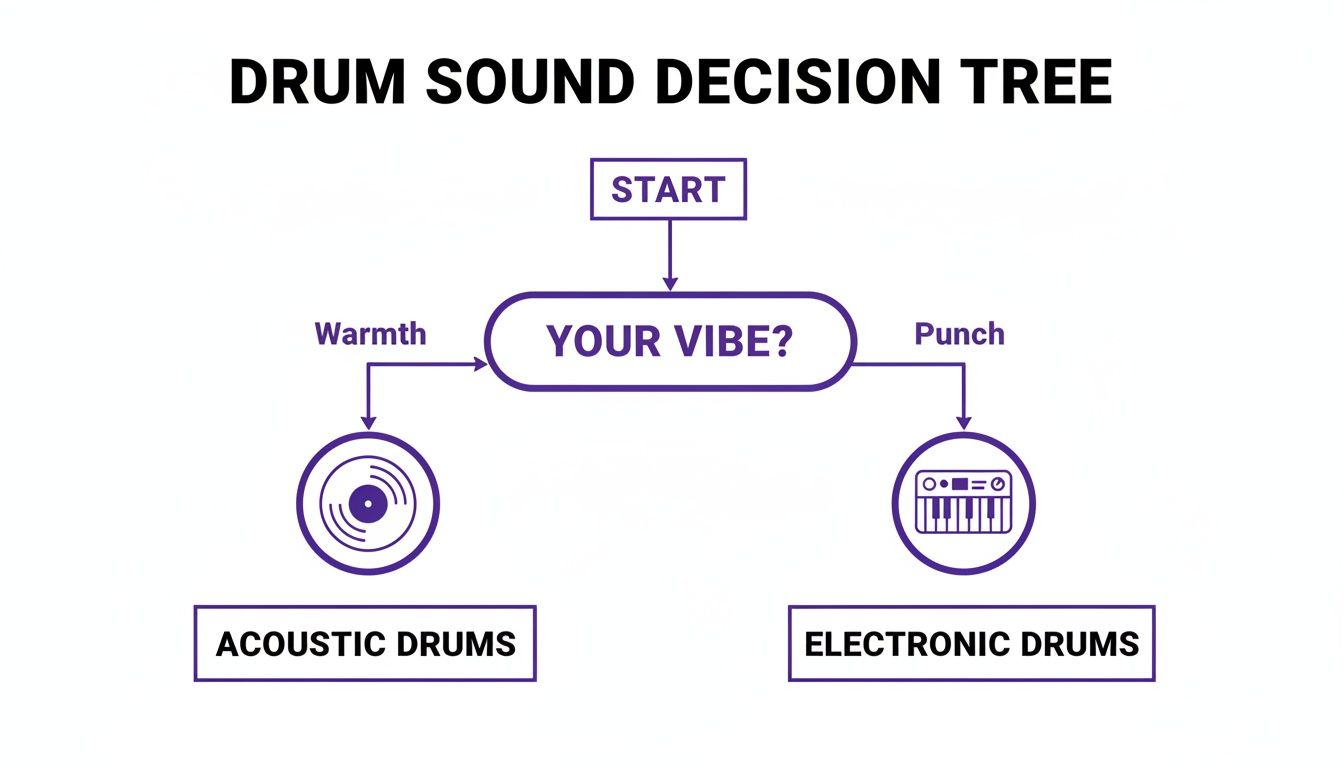
It really boils down to that fundamental choice between organic, vinyl-style textures and clean, synthesized power. That decision alone will guide most of your sound selection from the jump.
The Architect’s Choice: One-Shot Samples
One-shots are exactly what they sound like: individual drum hits. One kick. One snare. A single hi-hat. This approach gives you the absolute most creative control, making it the go-to for producers trying to build a truly unique rhythmic signature. You’re the architect here, placing every single sound exactly where it needs to go.
Using one-shots means you’re programming your patterns from scratch, usually in FL Studio’s Step Sequencer or Piano Roll. This lets you get surgical with your groove, creating complex hi-hat rolls, subtle ghost notes, and unique swing patterns that a pre-made loop just can’t touch. It takes more time, for sure, but the payoff is a beat that is 100% yours.
If you want to craft a signature sound, mastering programming with one-shots is non-negotiable. It forces you to think about rhythm and groove on a microscopic level—a skill every real beat-maker needs.
The Creative Spark: Drum Loops
Drum loops are pre-recorded rhythmic patterns, typically two to four bars long, that can instantly lay the foundation for a track. They are an incredible tool for breaking through writer’s block or just quickly sketching out an idea. When you find a loop with the right feel, it can set the tone for the entire song in seconds.
And loops aren’t just for beginners. Plenty of pros use them as a starting point. The trick is to make them your own—chop them up, rearrange the slices, or layer them with your own one-shots. This hybrid approach gives you the instant vibe of a loop with the custom feel of programming. For a massive library to get you started, you can find a ton of royalty-free hip hop loops and sound packs designed for exactly this.
The Learning Blueprint: Construction Kits
Construction kits take the loop concept a step further. Think of them as deconstructed beats. You get the full drum loop, but you also get the individual audio files (called “stems”) for the kick, snare, hats, and even the melodic parts. Many kits also throw in the MIDI files used to create the patterns.
This format is a goldmine for producers who are still learning the ropes. By picking apart how a professional beat is put together, you can learn a ton about arrangement, layering, and sound selection.
- Arrangement Insights: See how different elements come in and out to build tension and keep the track interesting.
- Mixing Practice: Use the stems to practice your mixing. Experiment with EQ, compression, and effects on individual sounds without messing up your own project.
- Creative Remixing: The MIDI files let you swap out the original sounds with your own, letting you remix the beat while keeping the pro-level groove.
The three formats—one-shots, loops, and construction kits—offer distinct paths for producers. This table breaks down how they compare side-by-side.
Workflow Comparison: One-Shots, Loops, and Construction Kits
| Criteria | One-Shot Samples | Drum Loops | Construction Kits |
|---|---|---|---|
| Creative Control | Maximum. Total freedom to build unique patterns from scratch. | Moderate. You’re working with a pre-made groove but can chop and layer it. | High. Full control over individual stems and MIDI patterns. |
| Speed | Slowest. Requires manual programming of every hit. | Fastest. Drag-and-drop for an instant groove. | Fast. Provides a complete song starter, ready for tweaking. |
| Learning Curve | High. Requires a good understanding of rhythm and programming. | Low. Very intuitive and beginner-friendly. | Moderate. Great for reverse-engineering pro arrangements. |
| Best For… | Crafting a signature sound and custom, complex rhythms. | Overcoming creative block and quickly sketching ideas. | Learning song structure, mixing, and remixing. |
Ultimately, there’s no “best” workflow—only the one that keeps you in the zone and making music. Don’t be afraid to mix and match. Start a track with a dope loop, program your own unique kick and snare under it with one-shots, and then pull up a construction kit to get ideas for the arrangement. Whatever gets the job done.
Getting Your Drum Kits Set Up and Organized in FL Studio
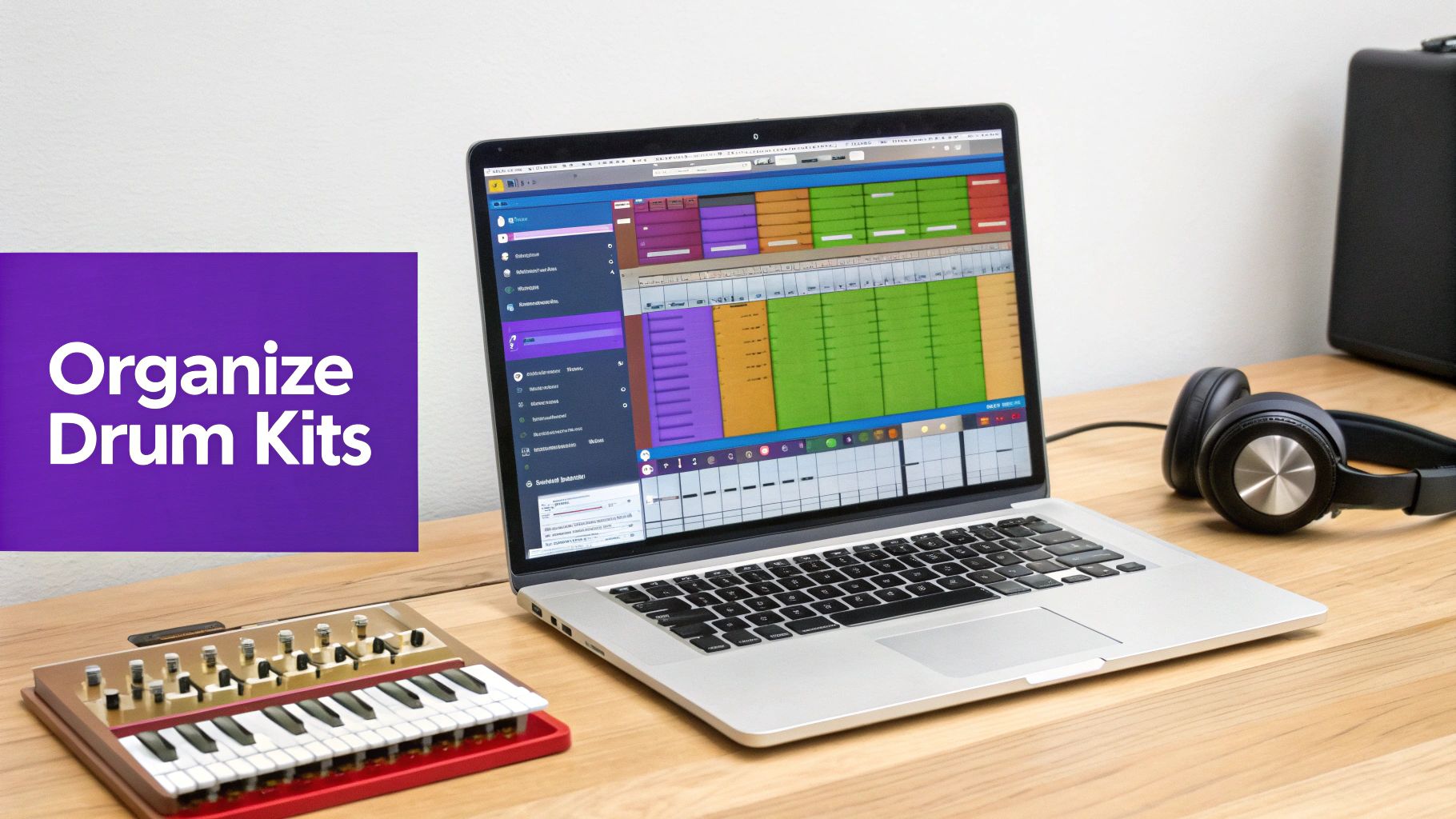
Grabbing the perfect hip-hop drum kit is only half the battle. The real test comes when inspiration hits—can you find that perfect snare before the idea fades? A messy sound library is a guaranteed vibe killer. Let’s be real, nobody wants to spend 20 minutes clicking through cryptic folders just to find a kick drum.
A clean, organized library isn’t just a nice habit; it’s a core part of a fast and fluid creative workflow. This section is all about getting your sounds dialed in within the FL Studio environment, so you can spend less time managing files and more time actually making music.
Setting Up Your Sound Library
First things first, you need a solid folder system. While you could just dump everything into FL Studio’s default folders, a much cleaner approach is to create a dedicated home for all your third-party sounds. This keeps things tidy and makes backups a breeze.
Here’s the simple, effective way to do it:
- Create a Central Folder: Find a spot on your computer (an SSD is best for speed) and make one main folder. Call it something obvious like “My Sample Library” or “Production Kits.”
- Link It to FL Studio: Open up FL Studio and go to Options > File Settings. In the “Browser extra search folders” area, click an empty folder slot and point it to the central folder you just made.
- Organize by Type: Inside that main folder, create some basic subfolders. Think “Drum Kits,” “Loops,” “FX,” and “One-Shots.” This keeps your library organized from day one.
Do this, and all your downloaded kits will pop up right in the FL Studio Browser on the left. No more hunting around. Just pure, drag-and-drop goodness.
Pro Tip: Your sound library should be an extension of your creative brain. Get in the habit of right-clicking your favorite sounds in the Browser and color-tagging them. It’s a simple trick that pays off big time when you need to grab your go-to snare in a split second.
Loading Sounds and Programming Patterns
Okay, library’s organized. Now for the fun part. FL Studio’s Channel Rack is where the magic starts. It’s the most direct and intuitive way to start building your drum patterns.
Just find a sound you like in the Browser—let’s say a kick—and drag it straight onto the Channel Rack. Boom. FL automatically loads it into a new channel, and you can immediately start clicking in steps on the Sequencer to lay down a rhythm.
This is the fastest way to get an idea out of your head and into the DAW. If you’re looking to build up a serious arsenal of sounds, exploring professionally curated FL Studio sound packs and kits will give you the high-quality source material you need to tackle any hip-hop subgenre.
Adding That Human Feel with the Piano Roll
The Step Sequencer is your workhorse for getting the basic groove down, but the Piano Roll is where you add the soul. To open it, just right-click any channel in the Rack and hit “Piano roll.” This is where modern hip-hop drums come to life.
- Complex Hi-Hat Rolls: Grab the Paint tool (Ctrl+B) to instantly draw in those rapid-fire hat rolls. Try setting the snap to 1/3 step to get those classic triplet bounces.
- Velocity Changes: The bars at the bottom of the Piano Roll control the velocity (how hard a note hits). Tweaking these is crucial for making your drums sound less robotic and more dynamic.
- Ghost Notes: Add some super quiet snare hits right before or after the main backbeat. These little “ghost notes” add a layer of professional groove you hear in all the best tracks.
- Note Nudging: The secret to getting that classic “Dilla” swing is to push your notes slightly off the grid. Hold the Alt key and drag a note to move it freely. These tiny timing imperfections make all the difference.
By combining the speed of the Step Sequencer with the fine-tuning power of the Piano Roll, you can take a simple drum loop and turn it into a professional, hard-hitting rhythm. It’s this seamless integration that makes FL Studio a beast for hip-hop production.
Essential Techniques for Professional Sounding Drums
Having a killer library of hip-hop drum kits is a great start, but it’s what you do with those sounds that separates the bedroom beats from the billboard hits. Think of great samples as raw ingredients; the real magic happens in the processing, mixing, and arrangement. This is where you take good drums and make them hit with an impact nobody can ignore.
It all starts before you even think about loading an effect. Smart sound selection is probably the most important step of all. Your kick and snare are the heart of the beat, so they absolutely need their own space to breathe. If you grab a deep, sub-heavy kick, pair it with a snare that has a sharp, mid-range crack. This simple choice prevents your low-end from turning into a muddy mess right from the get-go.
Carving Frequencies with EQ
Equalization (EQ) is your number one tool for creating that essential separation. The mission isn’t just to make one drum sound good on its own, but to make every piece of the kit fit together like a perfectly cut puzzle.
A simple high-pass (or low-cut) filter is your best friend. Use it on sounds that don’t need low-end information, like your hi-hats and cymbals. You’d be shocked how much mud this one move cleans up, instantly creating more room for your kick and 808 to really shine. For the kick itself, try a little boost around 60-100 Hz to add weight, and maybe another small bump between 3-5 kHz to bring out that clicky beater attack.
The secret to a clean mix isn’t what you boost, it’s what you cut. Carving out small frequency pockets in one sound to make space for another is how you get that professional clarity and punch.
Adding Punch and Character
Once your frequencies are playing nice, it’s time to shape the dynamics and add some vibe. This is where tools like compression and saturation come in.
- Compression for Punch: A compressor helps even out the volume of a sound. For drums, a slow attack setting is your ticket to punch. It lets that initial transient—the “smack” of the drum—cut right through before the compressor kicks in, making the whole thing feel way more powerful.
- Saturation for Warmth: Saturation is basically a fancy term for adding subtle harmonic distortion. It’s a fantastic way to give your drums that warm, fat character of vintage analog gear. It helps your drums cut through a busy mix without you having to crank the volume fader.
Speaking of gear, the market for the best drum kits for hip hop is telling a story. Projections show the electronic drums market, valued at USD 1.25 billion in 2025, is expected to hit USD 2.11 billion by 2032. North America holds a massive 35% of that market, largely because of the home studio explosion. In the US, where hip-hop dominates streaming with a 27% market share, it’s estimated that around 75% of bedroom producers rely on electronic kits. This is where resources like FL Studio Sound Packs become invaluable—packs like 2121 Greatest Snares give you royalty-free sounds that mimic the pro kits producers build their careers on. You can dig deeper into these trending drum market insights at Accio.com.
Advanced Techniques for Depth and Clarity
With the fundamentals locked in, a couple of advanced tricks can push your drums over the top. These techniques are all about creating a sense of space and solving those classic low-end battles common in hip-hop.
One of the most crucial is sidechain compression. In trap and modern hip-hop, the kick and 808 are always fighting for the same low-frequency turf. By sidechaining the kick to the 808, you can make the 808’s volume duck for just a millisecond whenever the kick hits. This simple trick creates a clean, powerful low-end where you can hear both elements perfectly.
Finally, don’t forget to give your drums some space with reverb and delay. A pro tip is to send your snare to an auxiliary track with reverb on it, instead of putting the effect directly on the snare channel. This keeps the original snare sound clean and punchy while giving you total control over the wet signal. A little bit of short, subtle reverb can make the snare feel like it’s in a real room, while a quick slap delay can add a ton of rhythmic energy and groove.
Your Go-To Checklist for Hip Hop Drum Kits
Picking the right drum kit for your hip-hop beats is about more than just grabbing sounds you like. It’s really about making a smart investment in your personal sound library. The right kit can be the difference between a beat that feels lifeless and one that ends up being the foundation for a hit record.
To make sure every pack you get is a solid asset, just run through this quick checklist before you click that “buy” button. Think of this as the final once-over, pulling together everything we’ve talked about to help you sidestep buyer’s remorse and build a pro-level collection you’ll use for years.
Getting the Basics Right
First things first, any kit you’re considering has to meet a certain standard of quality. These are the non-negotiables—the things that guarantee the sounds will actually work in your projects and hit the way they’re supposed to.
- Sound Quality: Are the samples clean and punchy? Listen closely for any unwanted digital clipping or weird noise (unless, of course, it’s a lo-fi kit and that’s the point). The sounds should feel professional right away, not like something you’ll have to fix with a ton of processing.
- Format Compatibility: Check if the files are in a standard format like 24-bit .WAV. This is key because it ensures the best possible quality and means they’ll work perfectly in FL Studio or pretty much any other DAW without any annoying conversion issues.
- Genre Authenticity: Does the kit actually sound like the genre it’s for? If you’re buying a trap kit, those 808s better have that deep, chest-rattling sub and a sharp attack. For boom bap, you’ll want snares with that classic dusty, sampled-from-vinyl character.
A drum kit is only as strong as its weakest link. If you’ve got massive kicks but the snares sound thin and weak, the whole pack loses its value. A truly professional kit is solid across the board, from kicks to cymbals.
Making Sure It’s a Good Creative Fit
Once a kit passes the technical check, you have to decide if it aligns with your personal workflow and the music you want to make. This is where you figure out if the sounds will genuinely inspire you and fit your style.
- Licensing Terms: This is a big one. Is the kit 100% royalty-free for commercial use? You absolutely have to know you have the legal right to use these sounds in songs you plan to put on Spotify or sell to other artists.
- The Inspiration Factor: When you listen to the demo tracks, do ideas immediately start popping into your head? The best hip-hop drum kits are the ones that make you want to fire up your DAW and start cooking up a beat right then and there.
Got Questions About Hip Hop Drum Kits? We Have Answers.
Every producer hits a point where they start digging deeper into their sound library, and that’s when the questions pop up. If you’re trying to figure out the best way to build your sonic arsenal, you’re in the right place. Let’s clear up some of the most common questions producers have about drum kits.
Drum Kit vs. Sample Pack: What’s the Real Difference?
It’s easy to get these two mixed up, but the distinction is pretty straightforward. Think of a drum kit as a specialist’s toolkit. It’s a focused collection of one-shot drum sounds—your kicks, snares, hi-hats, claps, and percussion. Its entire job is to give you the essential rhythmic pieces to build a beat from the ground up.
A sample pack, on the other hand, is more like a full construction site. It’s a much broader collection that often includes a drum kit but also brings melodic loops, basslines, vocal chops, FX, and sometimes even MIDI files or synth presets to the party. A drum kit is for building your groove; a full sample pack can spark the idea for an entire song.
Are Royalty-Free Kits Actually Safe for Commercial Tracks?
Yes, 100%. This is a big one, so let’s be clear: when a kit is labeled royalty-free, you pay a one-time fee for the license. That’s it. Once you’ve paid, you have the legal right to use those sounds in your music and release it commercially.
That means you can upload your tracks to Spotify, sell beats to other artists, or use them in TV and film projects without ever owing another dime to the original creator. It gives you total peace of mind and lets you focus on your music, not legal paperwork.
Using royalty-free sounds isn’t just a workaround; it’s a standard industry practice that protects your work. It ensures what you create stays yours, free from the messy licensing headaches and legal claims that can kill a track’s potential.
How Can I Get My 808s to Hit Hard Without Turning to Mud?
Ah, the classic 808 dilemma. Getting that perfect balance of power and clarity is a rite of passage for every hip hop producer. The secret isn’t just in the 808 itself, but in how it plays with your kick drum. The goal is to carve out space so they aren’t fighting for the same low-end frequencies.
First, always start with a high-quality 808 sample—garbage in, garbage out. Next, use an EQ to gently roll off the low-end frequencies on other instruments that don’t need to be down there, like pads or synths.
But the real game-changer is sidechain compression. Route your kick to a compressor on the 808 track. Tweak the settings so that every time the kick hits, the 808’s volume ducks just for a millisecond. This simple move creates a clean, punchy low-end where both the kick and 808 have their own moment to shine, giving you that hard-hitting, professional foundation every great beat needs.
At FL Studio Sound Packs, we’ve built a massive library of royalty-free drum kits, loops, and construction kits specifically to give your hip hop tracks that professional edge. Explore our collection and find the perfect sounds for your next hit.