What Is Royalty Free Music for Modern Beat Makers
Let’s cut through the confusion. When you hear the term royalty-free music, don’t think “free music.” Instead, think of it as a one-time pass for your creative projects. You pay once to get the rights to use sounds in your beats forever, without owing extra cash (royalties) every time someone streams your track.
What Royalty Free Music Really Means for Producers
It works a lot like buying software. Think about when you bought your copy of FL Studio. You paid for it upfront, and now you’re free to use that tool to make as much music as you want. Royalty-free music operates on that same straightforward idea. The “free” part means you’re free from ongoing payments, not free from cost or rules.
This licensing model is what unlocks a universe of professional-grade sample packs, loops, and MIDI files for beat makers. It’s your ticket to build, release, and monetize your music without the constant fear of legal headaches or surprise invoices from publishers down the line. Once you license a sound, it’s yours to use within the lines of the agreement.
The Core Concept: A One-Time Transaction
The traditional music industry is a tangled web of different royalties. Every time a song gets played on the radio, used in a movie, or streamed online, payments have to be made to songwriters and publishers. For an independent producer trying to get started, navigating that system is a nightmare.
Royalty-free licensing cuts through all that complexity. It boils everything down to a single, simple transaction. You find a sample pack you love, pay the license fee once, and that’s it. You can now flip those sounds into your next hit without losing sleep over who gets paid when your track hits a million streams on Spotify.
Key Takeaway: Royalty-free music is a licensing agreement where you pay a single fee to use a piece of audio in your projects as many times as you need, without paying additional royalties for recurring use.
Why This Matters for Your Beats
For music producers, this streamlined approach is a game-changer. It means you can pour your energy into being creative instead of playing amateur lawyer.
Here’s what it really gives you:
- Legal Peace of Mind: You can upload your tracks to YouTube, Spotify, and BeatStars with confidence, knowing you have the proper rights to every sound you’ve used.
- Budgetary Control: You know the exact cost of your sounds from the jump. No hidden fees or future percentages owed, which is crucial for managing your project budgets.
- Creative Freedom: This model gives you access to high-quality, professionally produced sounds, letting you compete with major label productions without needing a major label budget.
To get you up to speed quickly, here’s a simple breakdown of what these concepts mean for your workflow.
Royalty Free Music at a Glance for Beat Makers
| Concept | How It Impacts Your Beats |
|---|---|
| One-Time Payment | You pay once for a sample pack or loop and can use it in unlimited commercial tracks. |
| No Ongoing Royalties | You don’t owe anyone a percentage of your streaming revenue or sales from the beat. |
| License Agreement | Your rights are defined by a contract. Always read the fine print for any restrictions. |
| Commercial Use | Most royalty-free licenses allow you to sell your beats and collect 100% of the profits. |
| Focus on Creativity | Frees you from complex legal and financial tracking, letting you just make music. |
This table shows just how much royalty-free licensing simplifies things, letting you operate like a real business without the corporate overhead.
Ultimately, understanding what royalty-free music is empowers you to build a catalog of tracks that are legally solid and ready for the market. It’s the foundation for turning your passion for beat making into a sustainable business, one licensed sound at a time.
Why Royalty-Free Licensing Became a Producer’s Best Friend
To really get why royalty-free music is such a big deal, you have to look at how things used to be. For a long time, getting a song into any kind of project was a nightmare of complexity and cash. The whole system was a confusing maze of different rights, payments, and gatekeepers.
Picture this: you’re a TV producer back in the 90s. You want to use one popular song in your show. Get ready to open your wallet and call your lawyer. You’d need to negotiate a synchronization (sync) license to pair the song with visuals, pay mechanical royalties to reproduce it, and then fork over performance royalties every single time the show aired. Each check went to a different party—the publisher, the label, the songwriter—all tracked through collecting societies.
This old-school structure was built for major corporations with huge legal teams and even bigger budgets. It was never meant for the speed and scale of the modern creative world.
The Digital Shift and the Need for Speed
Then, the internet blew the doors off everything. Platforms like YouTube took off, and suddenly millions of independent creators needed music for their videos, podcasts, and games. At the same time, powerful Digital Audio Workstations (DAWs) like FL Studio put professional-grade tools right into the hands of bedroom producers everywhere.
A whole new creative economy was born, and it moved at the speed of an upload. A beat maker finishing a track in their home studio couldn’t wait weeks to haggle over a license or drop thousands on a single sample. The old system was a roadblock, locking out anyone who wasn’t a major player.
This multi-royalty mess was just too slow and expensive for the new wave of creators working on tight deadlines. Royalty-free music wasn’t just a happy accident; it was a necessary evolution to meet the needs of a new generation. For a little context, the global music copyright market is valued at around $47.2 billion in 2024—a massive industry still wrestling with this complex legacy. You can dig into more insights on the music copyright economy at pivotaleconomics.com.
Royalty-Free Music as the Solution
Royalty-free libraries didn’t just offer a cheaper option; they introduced a totally new model built for speed and simplicity. Instead of navigating a web of publishers and labels, a producer could now go to one place, pay a single fee, and walk away with a clear license to use a sound in their commercial tracks.
This streamlined process completely changed the game for producers in a few key ways:
- It kicked the gatekeepers to the curb. You no longer needed an “in” at a major label to get your hands on high-quality sounds.
- It brought legal clarity. A straightforward license agreement tells you exactly what you can and can’t do, protecting you from nasty copyright claims down the road.
- It made budgeting a breeze. You know exactly what you’re paying upfront, with no hidden fees waiting to take a chunk out of your future profits.
This shift handed the power back to the individual creator. It leveled the playing field, allowing independent producers to create, release, and monetize their music globally without needing corporate backing.
Think of it like this: the old system was like leasing a car where you had separate contracts for the engine, the wheels, and the stereo, each with its own per-mile fee. The royalty-free model is like buying the car outright. Once you’ve paid, you’re free to drive it wherever you want, as much as you want, without anyone else showing up asking for a cut.
This fundamental change is exactly why royalty-free licensing has become a modern producer’s best friend. It provides the legal and financial freedom you need to build a career in today’s music world, letting you focus on what actually matters: making incredible beats.
Decoding the Different Music Licensing Models
Navigating the world of music rights can feel like learning a new language. As a producer, you’re constantly hearing terms like royalty-free, copyright-free, and public domain thrown around, and it’s dangerously easy to get them mixed up.
Getting these terms straight isn’t just music theory trivia; it’s about protecting your beats, your money, and your entire career. One wrong assumption about a sound’s license can trigger copyright strikes, get your tracks pulled down, or even land you in legal hot water. Let’s break down what these models actually mean so you can make smart, safe choices for your music.
This diagram gives a great visual of how the tangled, old-school licensing system stacks up against the more direct model that royalty-free music offers producers today.
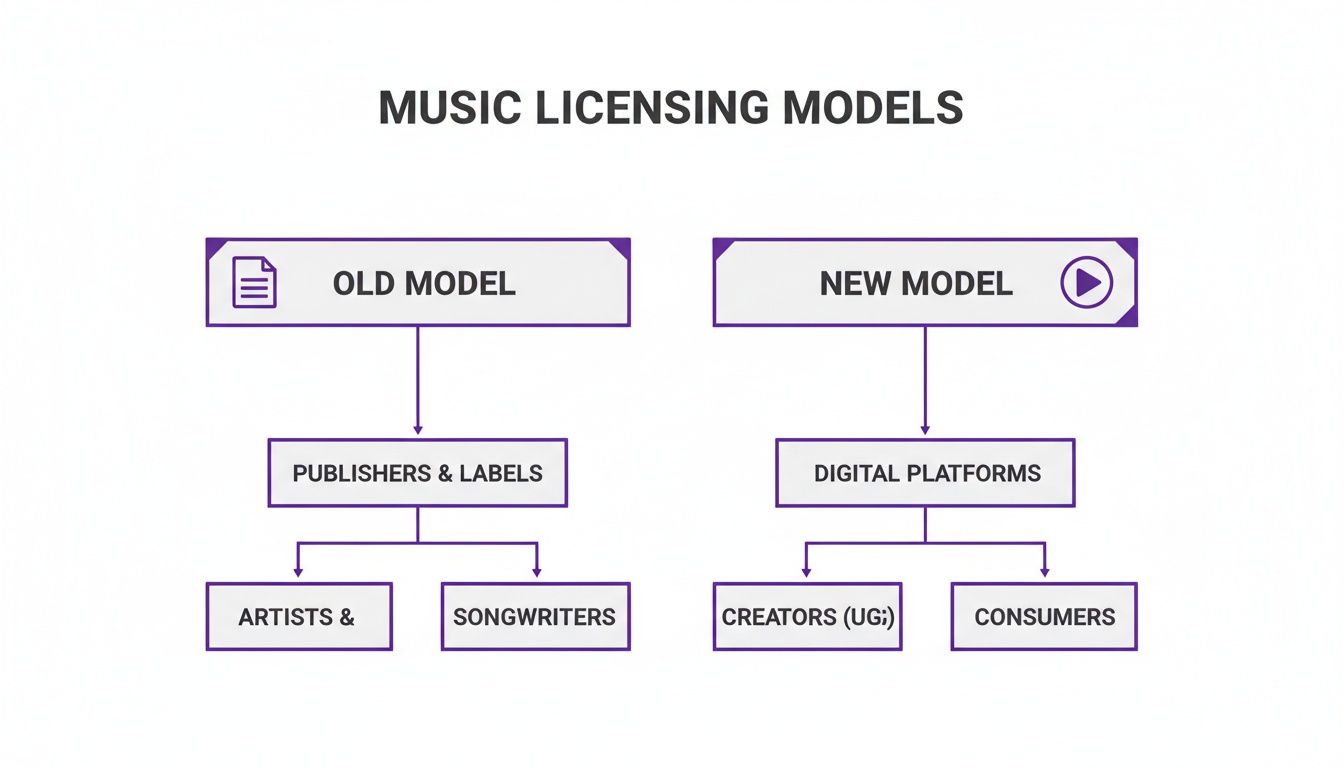
You can see the shift right away—from a confusing mess of middlemen to a straightforward path where creators can grab sounds with clear, upfront permissions. That simplicity is the whole point of royalty-free.
Royalty-Free: The Safe Middle Ground
As we’ve touched on, royalty-free is your go-to for making music you plan to sell or stream. It works like this: you make a one-time payment—either for a specific sample pack or a monthly subscription—which buys you a license to use those sounds in your own tracks.
You pay once, and that’s it. You’re free from paying any future royalties on that sound. This is the absolute gold standard for sample packs, loops, and drum kits because it gives you the legal green light to sell your beats and keep 100% of your earnings. The person who made the original sound gets paid by the library you bought it from, and you’re clear to monetize your work.
But “royalty-free” definitely doesn’t mean “rule-free.” Every license comes with its own set of dos and don’ts.
Crucial Point: A royalty-free license is a legal agreement. It will almost always forbid you from just re-packaging and selling the raw sounds as your own sample pack. You have to actually use them to create a new piece of music. For a real-world example of what to look for, check out the terms and conditions of a sound pack provider.
Copyright-Free: An Often Misleading Term
The phrase copyright-free sounds like the jackpot, but honestly, it’s a minefield of confusion and risk. Truly copyright-free music is incredibly rare. It would mean the creator has completely given up all their rights to the work, letting anyone use it for any reason without a single restriction.
More often than not, music you see labeled “copyright-free” on sites like YouTube is actually licensed under a Creative Commons agreement. That might mean you have to credit the original artist, or worse, it might block you from using it commercially at all. The biggest danger is that the person offering the sound might not even be the real owner, which leaves you wide open to a copyright claim from the actual rights holder down the line.
For any producer trying to build a business, relying on vague “copyright-free” sources is a massive gamble. Without a clear, provable license, you have zero legal ground to stand on if a claim pops up.
Public Domain: When Copyright Expires
Public Domain is a much clearer, legally defined category. Music enters the public domain when its copyright protection runs out. In the United States, this generally happens 70 years after the death of the last surviving author.
This means classical compositions from legends like Beethoven or Mozart are fair game. You can freely use their compositions in your work. But here’s the critical catch you can’t miss:
- The composition (the notes on the page) is public domain.
- A specific recording of that composition is protected by its own separate copyright.
So, while you’re free to cook up your own version of “Für Elise,” you can’t just sample the London Symphony Orchestra’s 2022 recording of it without getting a license. For most modern beat makers working in genres like trap or house, the public domain offers pretty limited material, and tracking down recordings that are truly clear to use is a serious challenge.
Music License Comparison for Producers
To make the right call for your tracks, it really helps to see these options laid out side-by-side. Each one has a totally different impact on your workflow, costs, and legal safety.
| License Type | What It Means for Your Music | Best Use Case | Potential Risk |
|---|---|---|---|
| Royalty-Free | Pay once for a license to use sounds in your commercial tracks. You keep 100% of your earnings. | Building a professional catalog of beats for sale, sync, and streaming. | Misunderstanding the license terms (e.g., reselling raw sounds). |
| Copyright-Free | Often means no restrictions, but the source and rights are frequently unclear. | Non-commercial projects, personal practice, or background music for casual videos. | High risk of copyright infringement if the music wasn’t truly free to use. |
| Public Domain | The copyright has expired, making the original composition free for anyone to use. | Re-interpreting classical music or using very old, confirmed public domain recordings. | Accidentally using a modern recording of a public domain work that is still copyrighted. |
At the end of the day, for any producer who wants to release music commercially, the choice is crystal clear. Grabbing a properly licensed, royalty-free sound from a reputable source is the only way to make sure you can build your career without constantly looking over your shoulder.
A Producer’s Checklist for Using Royalty-Free Sounds
Knowing the theory behind royalty-free music is one thing, but actually putting it to work in your studio without getting tripped up is a whole other game. This is your no-nonsense, practical guide for using every kind of royalty-free asset with confidence.
Think of this checklist as your pre-flight inspection before you upload a beat. Following these steps is your best defense against those dreaded copyright claims and legal headaches.
From a producer’s perspective, royalty-free sounds are really about managing risk and speeding up your workflow. It’s not about a specific musical style. Global publishing and copyright collections hit around €15.8 billion for creators in 2023. With streaming already surpassing $20.4 billion in 2024 and making up 69% of all recorded music income, platforms are constantly on the hunt for infringement. Using properly licensed sounds is the single best way to keep a beat you cooked up in FL Studio from getting flagged on Spotify or YouTube. Get a deeper look at the size of the music industry in 2025 at artists.badenstock.com.
Let’s break down the rules of engagement for the most common assets you’ll find in any pro sound pack.
One-Shot Drum Samples
One-shots are the easiest assets to work with, hands down. We’re talking about individual drum hits—a single kick, a snare, a hi-hat—that become the building blocks of your rhythm.
- What You Can Do: You have almost total creative freedom. Drop them in the Channel Rack to program your own unique drum patterns. Layer them, pitch them up or down, and drench them in effects to create a signature drum sound that’s all yours.
- The Main Restriction: The one big no-no is bundling up these
.WAVfiles and reselling them as your own drum kit. They have to be used within a larger musical creation.
Melodic and Drum Loops
Loops are pre-made musical phrases, like a four-bar guitar riff or a classic drum break. They’re amazing for instant inspiration, but they come with slightly tighter rules.
- What You Can Do: The license always requires you to use the loop in a new, original song. This means you absolutely have to add other musical elements around it—your own drums, a bassline, some synth chords, or vocals. A great way to make it your own is to chop, rearrange, or repitch the loop.
- What You Cannot Do: You can’t just drag a loop into your project, add nothing else, and call it a day. This is often called “loop layering,” and it’s a fast track to a copyright violation. Content ID systems are specifically designed to catch this.
Producer’s Rule of Thumb: If you’re using a melodic loop, think of it as just one ingredient in your recipe, not the whole meal. Make sure to add at least two or three other distinct musical or rhythmic elements to make the track legally yours.
MIDI Files
MIDI files are one of the most flexible and legally safe assets out there. Why? Because they contain musical data (notes, velocity), not actual audio.
- What You Can Do: This is where the magic happens. Load a MIDI file into an instrument channel in FL Studio and assign your own VST synth or sampler to it. Boom—you’ve instantly created a brand new, unique audio recording. You can tweak the notes, change the timing, and pick any sound you want. Since you generated the audio yourself, you own the copyright to that new performance. If you want some MIDI to mess around with, you can find a bunch of sound packs free for download that often include them.
- The Main Restriction: Just like with audio samples, you can’t turn around and resell the raw MIDI files. They’re tools for making music, not standalone products to be redistributed.
Stems and Construction Kits
Stems are the individual audio tracks that make up a full instrumental—you get separate files for the drums, bass, synths, and effects. They are incredible tools for both learning and creating.
- What You Can Do: Stems offer the ultimate control. You can completely rearrange a track, mute parts you don’t like, or swap out their synth stem for your own killer melody. The goal is the same as with loops: use these parts to build something new.
- The Main Restriction: You cannot just reassemble all the stems from a construction kit with zero changes and release it as your track. This is always forbidden and is easily flagged by copyright bots. You have to add your own creative spin, whether that’s a new melody, a full vocal performance, or a major structural remix.
Sticking to this checklist ensures you stay on the right side of every license agreement. It gives you the freedom to use royalty-free sounds with complete confidence, knowing the beats you upload are 100% yours to monetize and promote.
Alright, knowing the rules of royalty-free music is one thing. But turning that knowledge into a faster, more creative workflow? That’s where you really get an edge.
How you manage and use your licensed sounds can be the difference between a killer session and a frustrating one. Let’s get practical and talk about how to make that sound library work for you, not against you. The goal here is simple: squeeze every drop of creative juice from the sounds you’ve paid for, speed up your beat-making, and push your tracks to a new level.
Organizing Your Sound Library for Instant Access
Let’s be real—a messy sample folder is where creativity goes to die. We’ve all been there, wasting precious minutes digging through random folders just to find the right kick. It’s a vibe killer. But a little bit of structure can solve this for good, letting you find the perfect sound in seconds.
Most producers I know swear by a simple, tiered folder system. Here’s a super practical way to set it up so it works perfectly inside your DAW’s browser:
- Create a main “Sounds” folder: This is the mothership. Everything lives here.
- Organize by pack: Inside, make a folder for every single sample pack you own (e.g., “Platinum Swagg Kit,” “Electric Fire Guitar Loops”). No more guessing where that one loop came from.
- Sub-categorize by type: Within each pack’s folder, create subfolders like “Drums,” “Loops,” “MIDI,” and “Stems.”
- Get granular with drums: Inside that “Drums” folder, break it down even further into “Kicks,” “Snares,” “Hats,” and “Percussion.”
This structure makes auditioning sounds insanely fast. In FL Studio, you can just add your main “Sounds” folder to the Browser (hit F8), giving you immediate drag-and-drop access to your entire library without ever leaving the project.
Sparking Ideas with MIDI Files
MIDI files are easily one of the most powerful tools in any royalty-free pack. Because they’re just musical data—not locked-in audio—they offer almost limitless creative freedom. You’re not stuck with one sound; you can use a single MIDI file to drive any instrument you own.
Creative Tip: Try this. Drag a royalty-free chord progression MIDI file onto a channel in FL Studio. Now, start cycling through presets on your favorite synth VST. That same melody can sound completely different—and spark a whole new idea—when you hear it on a piano, a synth pad, or an aggressive lead.
This simple trick lets you create a 100% unique audio recording from a pre-made pattern. You can tweak notes, mess with the timing, and craft a melody that fits your track perfectly, all while knowing the final audio is yours to use.
Flipping Loops and Using Stems
Loops and stems are awesome for getting a track started fast. But the best producers rarely just drop them in and call it a day. The real magic happens when you chop, flip, and rearrange these audio files to make them your own.
- Creative Chopping: Drag a cool melodic loop into the FL Studio Playlist. Grab the Slice tool (shortcut: C), chop it into smaller pieces, and start rearranging the segments. You can create a totally new, original pattern in minutes.
- Learning from Stems: Any construction kit that gives you stems is a goldmine for learning. Load all the stems from a kit into your DAW and just listen. Deconstruct how a pro arrangement works. Notice how the bassline locks in with the kick, how the synths are layered, and how effects create space. It’s like getting a free production lesson.
When you start actively messing with these assets, you move beyond just using a sound and start truly incorporating it into your unique artistic vision. Not only does this keep you safe with licensing, but it’s also how you develop a signature style. Suddenly, your royalty-free library becomes an endless source of inspiration.
The Future of the Royalty Free Music Market
The royalty-free music space isn’t some tiny niche—it’s a massive, billion-dollar industry that’s getting bigger every day, all thanks to the world’s endless appetite for digital content. For music producers, this boom is nothing but good news. More competition means more sound designers are fighting for your attention, which results in a flood of high-quality, genre-specific sounds that can seriously push your creative limits.
This growth is being driven by the creator economy, which just keeps expanding. One industry analysis predicts the global royalty-free music market will jump from $1.43 billion in 2024 to a staggering $2.03 billion by 2030. What’s behind the surge? A constant need for licensed audio in YouTube videos, social media posts, podcasts, and small business ads. You can get more details on this market growth at datainsightsmarket.com.
This explosion in content means the market for our tools is bigger and more valuable than ever, making it a reliable source for professional sounds for years to come.
Why Clear Licensing Is More Critical Than Ever
As the market gets bigger, so does the technology used to police it. Platforms like YouTube and Spotify are using smarter and smarter Content ID systems. Think of them as automated bots that are constantly scanning every new upload for audio that hasn’t been cleared, making it incredibly risky to use sounds you don’t have a solid license for.
This is where a legitimate royalty-free license becomes your best friend. It’s not just a file download; it’s your legal shield, your proof that you have the rights to use that sound.
On top of that, we have the rise of AI music generators throwing another curveball. As AI starts creating its own sounds, the lines of who owns what can get blurry. Having a verifiable license from a trusted human source is becoming even more crucial to protect your tracks from false copyright claims and legal headaches.
Investing in properly licensed, royalty-free sounds is a forward-thinking strategy. It’s about building a sustainable career on a foundation of legal and creative security, ensuring your music can be monetized today and in the future without interruption.
Building a Sustainable Career
When you look at the big picture, the future for producers using royalty-free assets is incredibly bright. The market’s growth guarantees a steady stream of fresh, inspiring sounds to work with, while stricter copyright enforcement makes professional licensing a must-have part of any serious producer’s toolkit.
Here’s the simple game plan for your career:
- Invest in Quality: Think of a great sound library as an investment in your business, not just a purchase.
- Stay Protected: A clear license is your absolute best defense against copyright strikes and legal trouble.
- Focus on Creation: Let the license handle the legal stuff so you can get back to what you do best—making hits.
By getting your sounds from reputable providers, you’re not just buying loops and samples; you’re future-proofing your music career. For producers ready to build a massive, top-tier library without spending a fortune, checking out an unlimited downloads subscription is a no-brainer for both value and peace of mind.
Common Questions About Royalty-Free Music
Even when you’ve got the basics down, things can get a little fuzzy in the heat of a studio session. Let’s clear up some of the most common questions producers run into when working with royalty-free sounds. Think of this as your quick-reference guide for keeping your projects clean and legal.
Can I Use Royalty-Free Loops in a Song I Sell on Spotify?
Absolutely. That’s precisely what they’re made for. As long as you stick to the license agreement, you’re golden.
The main rule is almost always the same: you have to use the loop as part of a new, original song. Once you’ve done that, you can release your track everywhere—Spotify, Apple Music, you name it—and collect 100% of your earnings.
If I Use a Royalty-Free MIDI File, Who Owns the Melody?
You own the new audio you create. This is a crucial point many producers miss. MIDI files are just data—notes, velocity, timing—not actual sound.
When you drag that MIDI pattern into your project and have it trigger your own synth VST or piano plugin, you’re generating a brand new audio recording. The copyright for that specific performance belongs entirely to you.
This is a huge advantage for producers. It means one MIDI file can become a million different unique sounds that are legally yours. It gives you incredible creative and commercial freedom without getting tangled in licensing knots.
What if I Get a Copyright Claim on My Beat?
Don’t panic. If you sourced your sounds from a legitimate royalty-free provider, this is usually easy to resolve. Your license agreement is your proof—it’s the document that says you have the right to use that audio.
Simply head to the platform where you received the claim (like YouTube) and start the dispute process. You’ll be able to submit your license documentation, which should get the claim released quickly and keep your monetization safe.
Ready to build your library with sounds you can trust? FL Studio Sound Packs offers unlimited downloads of high-quality, 100% royalty-free sample packs, loops, and MIDI files. Find your next hit at https://www.flstudiosoundpacks.com.