
Finding the Best Trap Drum Kits for Your Beats
The best trap drum kits are more than just a folder of sounds—they’re a complete sonic toolkit built for making hits. A killer kit gives you everything you need right away: punchy 808s that shake the room, razor-sharp hi-hats that drive the rhythm, and snares that smack right through the mix.
What Separates Good Trap Drums From Great Ones
Anyone who’s spent time producing knows there are thousands of drum kits out there, all promising to give you that chart-topping sound. But here’s the secret: true quality isn’t about having hundreds of sounds. A great drum kit is a curated collection where every single file is usable and has a clear purpose.
Think of it like a master chef’s spice rack. A beginner might have dozens of random jars, but the pro has a select few high-quality spices that they know work perfectly together. It’s the exact same for trap drum kits. Each kick, snare, and 808 is designed to lock in with the others, saving you hours of frustrating mixing and EQ work.
This sonic cohesion is what really sets a professional kit apart. It’s the difference between a random grab-bag of sounds and a powerful, unified arsenal designed for modern beat-making.
The Foundation of a Professional Kit
Before you even get to the creative stuff, a professional kit has to nail the essentials. These are the sounds that form the backbone of almost every trap beat. They need to sound good everywhere, from studio monitors to car stereos and AirPods.
What does that look like in practice?
- Punch and Clarity: Every drum hit, especially the kick and snare, needs a clean, sharp attack that cuts through the mix without a ton of extra processing.
- Tonal Balance: The 808s should deliver massive low-end power without turning your track into a muddy mess. At the same time, the hi-hats need to be bright and crisp without sounding harsh or tinny.
- Sonic Consistency: All the samples in the kit should feel like they came from the same world. They just fit together, right from the start.
The goal of a premium drum kit isn’t just to give you sounds; it’s to speed up your creative process. When the fundamentals are this solid, you can stop fixing bad samples and start focusing on what matters—the music.
To break it down even further, let’s look at the individual pieces that make up a professional-grade trap kit.
Anatomy of a Professional Trap Drum Kit
This table gives you a quick snapshot of what to listen for in each core element of a kit.
| Drum Element | Key Sonic Characteristics | Role in the Beat |
|---|---|---|
| 808s | Deep sub-bass, clean attack, and controlled decay | Provides the melodic low-end and foundational weight of the track. |
| Kicks | Punchy, tight transients that cut through the 808 | Delivers the initial impact and rhythmic punch of the drum pattern. |
| Snares | Sharp, crisp attack with a body that adds character | Defines the backbeat (typically on the 2s and 4s) and provides energy. |
| Claps | Often layered with snares; adds texture and width | Enhances the snare hit, making it feel bigger and more impactful. |
| Hi-Hats | Clean, bright, and available in both closed and open variations | Drives the rhythm with intricate patterns (rolls, triplets, etc.). |
| Percs | Unique, textural sounds (rims, bells, foley) | Adds bounce, fills rhythmic gaps, and gives the beat a unique flavor. |
Each sound has a job to do. When they all work together seamlessly, you’ve found a kit that will genuinely improve your workflow.
Beyond the Basics: An Unmistakable Vibe
Finally, the absolute best trap drum kits have something you can’t quantify: an identity. They aren’t just generic, sterile sounds. They have a distinct vibe that can spark an idea for an entire track.
Maybe it’s a dark, gritty texture that’s perfect for drill-influenced trap, or a clean, polished sound that fits right into a pop-trap crossover. This curated character is what separates premium kits from the endless free packs you find online. You’re not just getting samples; you’re getting a sonic direction crafted by experienced sound designers.
This combination of cohesion and vibe is what empowers you to start making professional, hard-hitting beats the moment you load the kit up.
Deconstructing the Core Sounds of Trap
To really get what makes a great trap drum kit hit so hard, you have to look past the file names and dig into the sonic DNA of each sound. Every single element has a job to do. When they’re all crafted by an expert, they lock together to create that hard-hitting, rhythmically complex foundation that defines modern trap.
Let’s break down the sounds that truly matter.
The Heartbeat: Earth-Shaking 808s
The 808 is the undeniable soul of trap. It’s not just another bass note; it’s the track’s heartbeat, giving it both that deep, low-end weight and a surprising amount of melodic vibe. A pro-level 808 sample needs to walk a very fine line.
First, it absolutely must have a clean and powerful sub-bass region. This is the part you feel in your chest more than you hear, the pressure that makes a room shake and gives the track its physical presence. The problem? Pure sub-bass just vanishes on small speakers, like what you find on laptops or phones.
That’s where harmonic distortion comes in. A truly great 808 also has subtle mid-range harmonics that make it audible on any playback system. This bit of saturation adds character and grit, helping the bassline cut through the mix without becoming a muddy mess.
The Punch: Tight and Focused Kicks
If the 808 is the heartbeat, the kick is the punch that lands right on the chin. In trap, the relationship between the kick and the 808 is everything—they have to work together perfectly, not fight for the same space. A trap kick’s main job is to deliver a sharp, immediate attack.
It’s all about the transient, which is just the very beginning of the sound. A top-tier trap kick has a fast, punchy transient that slices right through the mix, giving the beat that initial impact. It needs to be short and tight, letting the body and tail of the 808 immediately take over the low end.
A classic mistake is using a kick with a long, boomy tail. It just crashes into the 808 and creates a muddy, undefined low-end. The best trap drum kits are packed with kicks designed specifically to complement 808s—they give you that initial click and punch, then get out of the way.
The Backbone: Snares That Crackle and Pop
The snare is the backbone of the beat. It provides that relentless energy that pushes the track forward. A great trap snare is a study in contrasts, really defined by two key parts: the “crack” and the “body.”
- The Crack: This is that high-frequency snap right at the start of the hit. It’s what makes the snare sound aggressive, sharp, and present in the mix.
- The Body: This is the mid-range tone that gives the snare its character and weight. It can be thick, thin, metallic, or raw, and it totally defines the drum’s vibe.
Professional sound designers often layer multiple sounds to get that perfect snare. They might mix a tight acoustic snare for its body with a sharp clap or a synthetic sound to add that signature crackle. This layering technique is exactly why the snares in the best trap drum kits sound so full and unforgettable.
To get an even wider palette, producers often dive into specialized sound libraries. If you want to move beyond basic trap sounds, exploring diverse collections of hip hop drum sounds can give you unique layers and textures to really make your snares pop.
The Engine: Hi-Hats That Drive the Rhythm
Hi-hats are the engine of trap music. They’re responsible for creating the genre’s signature bounce and crazy rhythmic patterns. They build tension, inject energy, and weave intricate patterns that keep listeners hooked. A quality kit will always have a variety of hi-hats for different jobs.
- Closed Hats: These are the workhorses you use for those rapid-fire rolls, triplets, and stuttering patterns. They need to be crisp, clean, and short.
- Open Hats: Used for accents and transitions, an open hat adds a quick burst of sustained energy. A good open hat sample has a clean decay that doesn’t muddy up the mix.
It’s interesting to look at the market for these sounds. While big names like Yamaha and Pearl dominate the acoustic drum world with a combined 35% market share, the demand for digital drum sounds is way more specific. Snares and hi-hats make up a combined 31% of component sales, which just shows how critical they are in genres like trap. You can discover more insights about the drum kit market from Business Research Insights to see how these trends shape the samples that end up in our DAWs.
Why Technical Quality Is a Deal-Breaker
Ever found an 808 with the perfect gritty tone, only to hear it fall apart the second you add a little EQ? That’s the moment technical quality stops being a boring spec and starts messing with your music. An amazing sound is totally useless if it can’t hold up under pressure.
When you’re digging for the best trap drum kits, the vibe and character of the sounds are just one side of the coin. The other side is the nerdy-but-critical stuff: file formats, bit depth, sample rate, and how the whole thing is organized. Getting these details right is what separates a pro-level kit from a folder of random sounds.
Think of it like cooking. You can have an amazing recipe, but if you start with cheap, low-quality ingredients, your final dish is never going to be great. It’s the exact same with drum samples—premium ingredients give you the freedom to cook up a masterpiece.
The Gold Standard File Format
In the world of professional audio, one format is king: the 24-bit/44.1kHz WAV file. This isn’t just some arbitrary choice; it’s a practical must-have for producers who need maximum flexibility from their sounds.
A WAV file is completely uncompressed. That means it holds 100% of the original audio data from the moment it was recorded or designed. Unlike an MP3, nothing gets thrown away to make the file smaller.
So why does that matter so much for making trap?
- Processing Headroom: Trap drums get abused in the mix. We pitch 808s all over the keyboard, saturate snares until they scream, and carve out hi-hats with aggressive EQ. 24-bit audio gives you a massive dynamic range, meaning you can make these wild changes without introducing nasty digital noise or artifacts. Try doing that to an MP3, and it’ll sound thin and brittle in seconds.
- Keeping It Clean: Every time you process or re-export a compressed file, you lose a little more quality. Starting with a high-quality WAV ensures that the original punch and clarity of your drums stay intact all the way through production, mixing, and mastering.
When you grab a drum kit, you’re not just buying sounds—you’re investing in raw sonic material. A kit full of 24-bit WAVs is like getting a block of pristine clay you can mold into anything. A kit of MP3s is like being handed pre-hardened pottery that just cracks under pressure.
Organization Is a Workflow Superpower
Beyond the files themselves, the way a kit is organized can be the difference between a lightning-fast creative flow and a frustrating scavenger hunt. A professionally made kit is built to speed up your workflow, not get in your way.
Honestly, this is one of the biggest signs of a quality product. It shows the person who made it actually understands what producers need day-to-day.
Key and Tempo Labeling
For modern trap production, this is non-negotiable. When an 808 is labeled “808 – Gritty Saw (G#),” you can instantly drag it in and tune it without pulling out a spectrum analyzer. The same goes for melodic one-shots or tuned kicks. BPM labels on loops let you time-stretch them perfectly with one click.
This simple info saves you minutes on every single beat. Those minutes add up to hours, keeping you locked in the creative zone instead of getting bogged down with technical chores.
Logical Folder Structure
A great kit doesn’t just dump 500 files into one massive folder. It uses a clean, intuitive structure that makes finding the right sound feel effortless.
A typical pro structure will look something like this:
- [Kit Name]
01 - 808s & Bass02 - Kicks03 - Snares04 - Claps & Rims05 - Hi-Hats (Closed & Open)06 - Percussion07 - FX & Vox
This simple layout lets you jump right to the category you need, so you can audition sounds quickly and keep the momentum going. When every second counts, a well-organized toolkit is your best friend. The best trap drum kits respect your time by making everything easy to find.
Understanding Royalty-Free Drum Kits
Let’s be real, the legal side of making music can feel like a minefield. But if you’re serious about your career, there’s one term you absolutely need to get straight: royalty-free. When you grab a fire trap drum kit, you’re not just downloading sounds—you’re getting a license. That license is the rulebook for what you can and can’t do with your beats.
Think of “royalty-free” as your golden ticket for commercial use. It simply means you pay once for the kit, and that’s it. You’ll never owe the creator another dime in royalties, no matter if your track blows up and goes multi-platinum. It’s a clean, one-and-done deal that gives you total creative and financial control.
What Does Royalty-Free Really Mean?
Imagine buying a professional-grade power drill. You pay for it once at the store. From that day forward, you can build and sell as many custom cabinets as you want, and you don’t have to send the drill company a cut of your profits. The tool is yours to use for your business, forever. That’s exactly how a royalty-free drum kit works.
This is a world away from other licenses where you might have to cough up a percentage based on your streams, sales, or sync placements. With a royalty-free license, the road ahead is clear: make your beat, sell it, and keep 100% of the money.
This is the single most important factor for any serious producer. A royalty-free license is your legal assurance that the music you create is truly yours to monetize, protecting you from potential lawsuits and financial claims down the line.
The demand for these kinds of legally-cleared sounds is exploding. The global drum kit market was already valued at around USD 1.2 billion in 2023 and is on track to hit nearly USD 1.9 billion by 2033. This boom just proves how many independent producers are out there looking for professional sounds to build their careers on. You can dig deeper into this market growth and what it means for producers over at datahorizzonresearch.com.
Common Permissions and Restrictions
Even though “royalty-free” gives you a ton of freedom, it doesn’t mean anything goes. Every license has a clear set of rules to protect both you and the person who made the sounds. Taking a minute to understand these terms is how you stay on the right side of copyright law.
Here’s what you can almost always do with a royalty-free drum kit:
- Create Commercial Music: Drop your tracks on Spotify, Apple Music, and anywhere else you release music.
- Use in Sync Placements: Get your beats into TV shows, movies, video games, or commercials.
- Perform Live: Use the sounds in your tracks for live shows and DJ sets without any issues.
On the flip side, there are always a few ground rules. The biggest one is almost universal:
- No Reselling Raw Sounds: You can’t just take the WAV files from the kit, repackage them, and sell them as your own sample pack. Your license is for using the sounds to make music, not for reselling the original product itself.
Always, always check the license agreement before you buy. It’s a non-negotiable step. Reputable sellers, like the ones providing the huge variety of sound packs for beats, will always have their terms laid out clearly. That transparency is what lets you create with confidence, knowing you won’t get hit with legal trouble later.
How to Customize Your Drums in FL Studio
Grabbing a fire trap drum kit is just the start. The real artistry begins when you take those pro-quality samples and twist them into something that sounds like you. This is where a powerhouse DAW like FL Studio really shines, giving you all the tools you need to turn great sounds into your signature sound.
Think of it this way: a premium drum kit gives you the perfect ingredients. But you’re the chef. The goal isn’t to fix bad sounds—a quality kit already took care of that. It’s about adding your own flavor and making sure your beats knock harder than anything else out there.
This simple workflow is why royalty-free kits are a game-changer. You can go from buying a pack to releasing your track with total creative freedom and zero legal headaches.
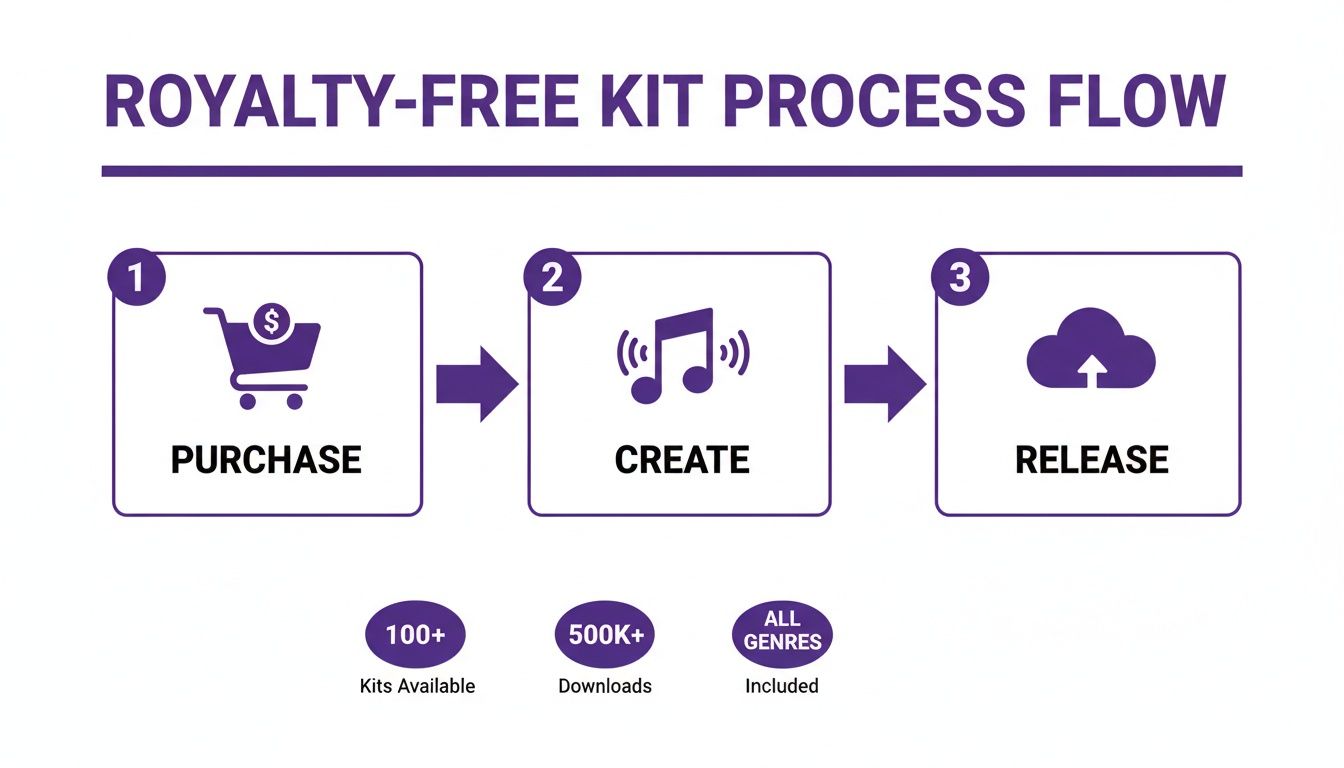
This process lets you pour all your energy into the music itself, without ever having to look over your shoulder about sample clearance. It’s all yours.
Give Every Drum Its Own Space
If you only do one thing, do this: route every single drum sound to its own mixer channel. When you first drop sounds into the Channel Rack, they all feed into the Master fader. That’s like having your whole drum line yelling into one microphone—a guaranteed recipe for a muddy, chaotic mess.
Sending your kick, snare, hi-hat, and 808 to their own dedicated mixer tracks gives you surgical control. Suddenly, you can:
- Beef up your kick: Add some saturation to make it punch through the mix, or use an EQ to carve out a pocket for the 808.
- Give your snare some air: Add a touch of reverb to give it a sense of space without turning your whole beat into a blurry wash.
- Widen your hi-hats: Use a stereo shaping tool to spread them out, making your rhythm feel bigger and more immersive.
This separation is the absolute foundation of a clean, professional mix. It lets you treat each sound on its own terms, ensuring every piece of your groove hits exactly how you want it to.
Create Custom Textures with Layering
Why use one snare when you can stack three? Layering is a classic trap production secret for creating massive, one-of-a-kind drum sounds that nobody else has. The idea is simple: you stack multiple samples to play at the exact same time, combining their best qualities into one super-sound.
A classic trap snare layer might look like this:
- A punchy snare for that powerful, mid-range body.
- A sharp clap right on top to add a bright, crispy attack.
- A gritty rimshot or noise sample tucked quietly underneath for some unique texture.
The real magic is in the details. Tweak the volume of each layer. Try nudging one of the samples just a few milliseconds forward or back to change how the initial transient hits. This technique gives your drums a weight and character that a single sample could never achieve on its own.
Master the Piano Roll for Dynamic Bounce
Nothing screams “amateur beat” like static, robotic hi-hats. The iconic bounce and roll of trap music is born in FL Studio’s Piano Roll. This is where you breathe life into your rhythms.
Start by laying down a basic two-step hi-hat pattern. Now, let’s make it groove:
- Velocity is Everything: This is your most important tool. Drastically change the velocity (volume) of individual notes. Turn some hits way down to create subtle “ghost notes” that give the pattern a human feel.
- Play with Pitch: Slightly pitching certain hi-hats up or down adds a subtle melodic feel to the rhythm, keeping things interesting.
- Use the Stereo Field: Pan some of your rolls and ghost notes slightly to the left or right. This makes your hats feel wider and more engaging, especially in headphones.
A great rhythm isn’t just about what notes you play—it’s about how you play them. Using velocity and panning in the Piano Roll turns a boring pattern into a living, breathing groove that hooks the listener in.
Tune Your 808s and Make Them Punch
An out-of-tune 808 will kill your track’s vibe instantly. Because 808s carry the bass melody, they must be in the same key as your synths and other instruments. Getting this right in FL Studio is easy. Just open the sampler, right-click the waveform, and choose “Edit in pitch corrector (Newtone).” Newtone will literally show you the root note of the sample.
Once you know the key, head back to the sampler’s Miscellaneous Functions tab and set the root note. Now, every note you play in the Piano Roll will be perfectly in tune.
To make sure your 808 and kick can coexist peacefully, use FL Studio’s stock Fruity Parametric EQ 2. A classic trick is to find the kick’s main frequency and give it a slight boost, then make a small cut at that exact same frequency on the 808’s EQ. This carves out a perfect pocket for the kick to punch through without creating low-end mud. For a deeper dive, our guide on how to produce trap beats with FL Studio breaks down these mixing techniques step-by-step.
Your Questions About Trap Drum Kits Answered
As you get deeper into trap production, a few questions always seem to pop up. Let’s clear the air on some of the most common hurdles producers face so you can spend less time guessing and more time making bangers.
What Is the Difference Between a Drum Kit and a Loop Pack?
This is a classic one. A drum kit is your collection of individual, one-shot sounds—think a single kick, one snare, a specific hi-hat. These are your raw ingredients, the building blocks that give you total freedom to create any rhythm or pattern from the ground up. The best trap kits provide a whole palette of these sounds that already feel like they belong together.
A loop pack, on the other hand, gives you pre-made drum patterns. You just drag, drop, and you’ve got an instant vibe to build on. High-quality trap drum kits often include both one-shots and loops, giving you the best of both worlds for whatever your workflow demands.
How Do I Make My 808s Hit Harder Without a Muddy Mix?
Getting that chest-thumping 808 without turning your low-end into a swampy mess is an art form, but the secret is pretty simple: create space. Always start with a great 808 sample—one that has both that deep sub-bass rumble and some harmonics you can actually hear on smaller speakers. From there, it’s all about managing frequency clashes.
The most powerful trick in the book is sidechaining your 808 to the kick. This simple move ducks the 808’s volume for a split second right when the kick hits. The kick gets to punch through clean and sharp, and then the 808’s massive bass takes over right after.
This separation gives both elements their own moment to shine, ensuring they hit with maximum impact instead of fighting each other.
Are Free Drum Kits Safe for Commercial Releases?
Tread very carefully here. Using free drum kits you find scattered online for commercial tracks can be a huge risk. A lot of those free packs are put together with samples ripped from other songs or have totally unclear licensing, which can land you in serious legal trouble with copyright claims later.
For any track you plan to sell, stream, or get placed, you absolutely must use sounds that are explicitly labeled as 100% royalty-free. That’s your legal guarantee that you have the right to profit from your music without worrying about lawsuits or having to split your earnings down the line.
Ready to build your library with professional sounds you can legally use everywhere? FL Studio Sound Packs offers a massive collection of royalty-free trap drum kits, loops, and MIDI files designed to help you create chart-ready beats instantly. Get the sounds you need to succeed at https://www.flstudiosoundpacks.com.