Your Guide to Finding the Best FL Studio Sample Packs Free Online
Staring at a blank project in FL Studio can feel a little intimidating, but you definitely don’t need a huge budget to fill it with fire sounds. The truth is, there’s a massive universe of high-quality, FL Studio sample packs free of charge just waiting to be discovered. These packs give you professional-grade drum kits, loops, and MIDI files without you ever having to pull out your wallet.
Exploring the World of Free FL Studio Sample Packs
The old idea that “free” means low-quality is a total myth in modern music production. These days, countless sound design companies, big-name producers, and online communities drop incredible sound libraries to help new producers get started, promote their premium stuff, or just give back. We’re not talking about throwaway sounds here; these are often meticulously crafted elements that can become the backbone of your next banger.
This kind of access is a game-changer, especially for producers in genres like hip-hop, trap, and EDM, where the right drum sound or melodic loop is everything. Instead of being stuck with stock sounds, you can start building a unique and versatile library that really reflects your own style.
The Different Flavors of Free Packs
As you start digging for free packs, you’ll see they usually come in a few common formats. Knowing what each one does helps you grab exactly what you need for a project.
- Drum Kits: This is your bread and butter—collections of one-shot drum sounds like kicks, snares, claps, hi-hats, and all kinds of percussion. They’re essential for programming your own custom beats from the ground up.
- Loop Kits: These packs contain pre-made melodic or rhythmic phrases. Think of a guitar riff, a piano chord progression, or a full drum beat ready to go. They’re perfect for sparking an idea fast or adding layers to a track you’re already working on.
- MIDI Packs: Instead of audio, these packs give you MIDI data. You can drag a MIDI file onto an instrument channel in FL Studio and use it with any VST synth or sampler you have. This gives you total control to change the sound, the notes, and the rhythm.
- Construction Kits: A construction kit is basically a deconstructed song. It comes with all the individual audio files (or “stems”) used to make a short musical piece—the drums, bass, melody, and chords are all separated into their own WAV files.
To make it even clearer, here’s a quick breakdown of what you’ll find out there.
Quick Guide to Free Sample Pack Types
| Pack Type | Primary Content | Best For |
|---|---|---|
| Drum Kits | One-shot drum sounds (kicks, snares, hats) | Building custom beats from scratch and controlling every hit. |
| Loop Kits | Pre-made melodic or rhythmic phrases (WAV) | Quickly sparking song ideas or adding layers to existing tracks. |
| MIDI Packs | Note and rhythm data (.mid files) | Gaining full control over melodies and chords with your own VSTs. |
| Construction Kits | Separated stems of a full musical idea | Learning song structure and remixing professional arrangements. |
These are the main types you’ll run into, and each serves a different creative purpose.
For a new producer, construction kits are invaluable learning tools. They show you exactly how a professional track is layered and arranged, providing a blueprint you can study and manipulate.
Why Even Pro Producers Rely on Free Sounds
Don’t think for a second that free packs are just for beginners. Even top-tier producers with big budgets keep a huge arsenal of free sounds. Why? Because a unique snare from some obscure free kit might have the exact texture they need to make a beat truly stand out.
Plus, many premium sound designers offer “taster packs,” which are small, free versions of their larger paid products. This is a perfectly legitimate way to get your hands on professionally designed sounds and test a company’s quality before you even think about buying. Building your library with these freebies ensures you have a diverse sonic palette to pull from, helping you turn a simple idea into a fully-fledged, professional-sounding track.
Where to Find Legit Royalty-Free Sample Packs
Finding free sounds online is one thing, but finding high-quality, legitimate, and safe downloads? That’s a whole different ball game. The internet is littered with sketchy websites offering sounds that are either terribly low-quality, stolen, or worse, bundled with malware.
To build a professional sound library, you have to stick with reputable sources that guarantee their samples are 100% royalty-free. This is the only way to ensure you can use the sounds in your commercial releases without getting hit with copyright strikes or legal headaches down the road. Focusing on trusted platforms not only protects your music but gives you access to professionally engineered audio that will make your tracks shine. These are the places seasoned producers go for reliable, inspiring sounds.
Industry Staples for Free Downloads
When you’re hunting for top-tier FL Studio sample packs free of charge, a few names always pop up, and for good reason. These companies have built their reputations by offering incredible value and quality, even in their freebie sections. They get it—giving producers a taste of their premium sounds is the best way to build a loyal following.
- Cymatics: A giant in the sound design world, Cymatics is legendary for its massive free download vaults. They constantly drop taster packs for their premium collections, covering everything from hard-hitting trap drums to lush melodic loops. It’s an essential bookmark for any producer.
- Loopmasters: As one of the longest-running sample stores out there, Loopmasters offers a huge selection of free “taster packs” across just about every genre imaginable. Signing up for their newsletter usually gets you access to a rotating library of free sounds from some of the best in the business.
- Producer Loops: Much like Loopmasters, this platform provides a generous lineup of free packs that let you test-drive their premium products. It’s a fantastic way to explore different genres and stumble upon unique sounds you might not have found otherwise.
These sites are more than just download portals; they are communities and educational hubs. Honestly, exploring their blogs and tutorials can be just as valuable as the sounds themselves.
Hidden Gems and Community Favorites
Beyond the major players, there are other incredible sources that have earned the respect of the producer community. These spots often specialize in niche genres or styles, offering unique sounds that can help you carve out your own signature style.
Myloops, for instance, has been a key player for a long time. Back in 2009, they kicked off their journey by offering free sample packs and have stuck with it ever since, building up a library of over 6GB of royalty-free WAV loops, trance MIDI files, and other sounds. This was a game-changer for beat makers on a budget, giving them access to high-quality resources without the premium price tag. You can learn more about the history of their free offerings on the Myloops official site.
Another killer source is the official creator of FL Studio itself, Image-Line. They provide their own free content that is, of course, perfectly optimized for the DAW.
Don’t sleep on the official Image-Line FPC Free Kits. These are professionally designed drum kits made specifically for the Fruity Pad Controller plugin, giving you instantly playable, high-quality drum sounds right out of the box.
Vetting Your Sources for Safety and Quality
Even when you find a source that looks promising, it pays to do a quick check to make sure you’re downloading safely. A legit provider will always be transparent about licensing and will never make you click through a maze of pop-up ads or shady download links.
Before you hit that download button, keep an eye out for these signs of a trustworthy source:
- Clear Licensing Info: The site should clearly state that the samples are “royalty-free” or “100% royalty-free for commercial use.” If you can’t find a license agreement, proceed with caution.
- Professional Website: Legitimate companies invest in a clean, professional web presence. A site cluttered with broken links, intrusive ads, or a confusing layout is a big red flag.
- Audio Previews: Any reputable source will let you hear the sounds before you download. No demos or previews? You have no idea what you’re actually getting.
- Direct Downloads: The process should be simple. If a site redirects you multiple times or asks you to install some weird software to get your files, just close the tab and move on.
By sticking to these guidelines and focusing on established platforms, you can confidently build a massive, diverse library of FL Studio sample packs free from legal and technical nightmares. For a curated starting point, you might want to explore our collection of free sounds for FL Studio to jumpstart your library.
Installing and Organizing Your Sample Library
So, you’ve scored a killer collection of free FL Studio sample packs. That’s a huge win, but honestly, it’s just the starting line. The real magic happens when you can grab the perfect sound the instant an idea hits, without killing your creative momentum digging through a chaotic mess of folders.
A well-organized library isn’t just a nice-to-have; it’s a core part of a fast, professional workflow. Let’s get those new sounds out of your ‘Downloads’ folder and plugged right into FL Studio where they belong.
Connecting Your Folders to the FL Studio Browser
First things first, you need to tell FL Studio where you stashed your new samples. By adding your main sample folder to the FL Studio Browser, all your kits will pop up in the left-hand panel, ready to drag and drop.
This is way better than navigating through your computer’s file explorer every single time. It keeps everything inside the FL Studio environment, which is crucial for staying locked in a creative flow.
To set this up, just head to Options > File Settings. You’ll see a section labeled “Browser extra search folders.” This is where you’ll point FL Studio to your sound library.
As you can see, you can add a bunch of different folder locations. Just click an empty folder slot, find where you saved your downloaded packs, and select it. As soon as you do, it’ll appear in the Browser panel on the left side of your screen. Easy.
Pro Strategies for Folder Organization
Okay, adding the main folder is a start, but a little strategic organization will save you countless hours down the road. Whatever you do, don’t just dump every downloaded pack into one giant folder. In a few months, it will be a nightmare to navigate.
Instead, think like a librarian. The goal is to create a structure that makes sense to you and the way you make music.
A great starting point is to create a main folder on your hard drive—something simple like “My Sample Library.” Inside that, you can start sorting.
A common mistake I see producers make is organizing by the name of the pack, like “Cymatics Cobra Hip Hop Pack.” A few months later, you’ll never remember that name. A much better approach is to organize by the type of sound.
Here are a few proven methods you can use or mix and match:
- Organize by Instrument: This is a classic for a reason. Create top-level folders like “Drums,” “Melodic Loops,” “Vocals,” and “FX.” Inside “Drums,” you can get even more specific with sub-folders for “Kicks,” “Snares,” “Hi-Hats,” and so on.
- Organize by Genre: If you jump between different styles, this is a lifesaver. Make folders for “Trap,” “House,” “Lo-Fi,” and “Cinematic.” Then, inside each of those, you can sort by instrument.
- Organize by Creator: Sometimes you download a pack because you just love the sound design of a specific creator (think Cookin Soul or Beat Butcha). Keeping their kits together in their own folder can be super useful when you’re trying to capture a certain vibe.
The best system is usually a hybrid that fits your personal workflow. For instance, your folder structure might end up looking something like this:
My Sample Library > DRUMS > Kicks > Trap Kicks My Sample Library > MELODIC LOOPS > Piano > Sad My Sample Library > MELODIC LOOPS > Guitar > Jazz
This level of detail means you can find exactly what you’re hearing in your head in seconds flat.
Advanced Tips for a Flawless Workflow
Once your folder structure is locked in, a few extra FL Studio tricks can speed things up even more. These are the small habits that separate the pros who finish tracks from those who spend half their time just looking for files.
Color Code Your Favorites Inside the FL Studio Browser, you can right-click any folder and give it a color. Use this to your advantage!
- Right-click your absolute favorite, go-to drum folder.
- Select “Color…” from the menu.
- Pick a bright color that stands out, like red or yellow.
Now, that folder will always catch your eye, letting you get to your most-used sounds instantly.
Smart Naming Conventions When you download a new pack, take two minutes to rename the files if they have generic names. A file named SNARE_final_04_rev2.wav is completely useless. A quick rename to something descriptive like Snare_Punchy_Trap.wav or Snare_LoFi_Vinyl.wav makes searching within FL Studio’s Browser way more powerful.
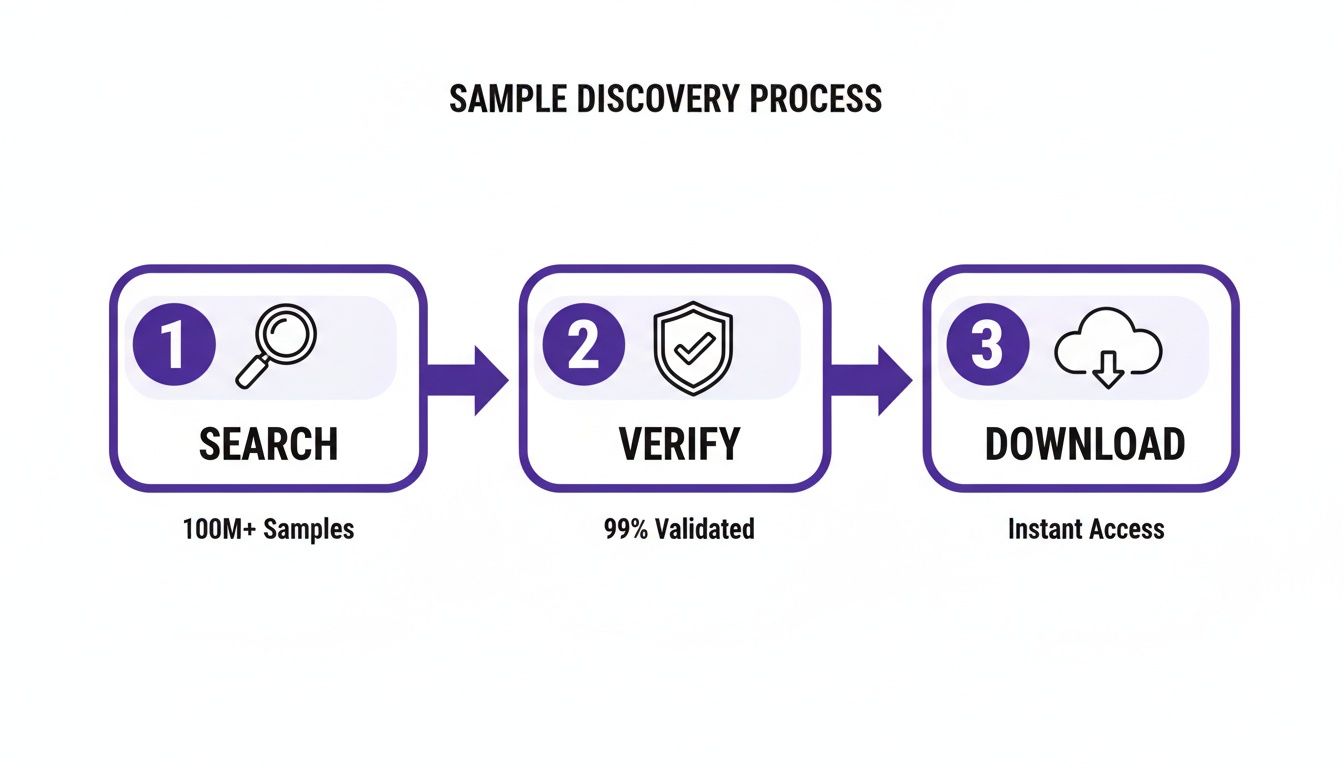
This simple flow—finding sounds, checking that they’re legit, and downloading them—is the foundation. But what you do after the download is what truly defines your workflow.
Putting in the time upfront to properly install and organize your library will pay you back in every single production session from now on. For a deeper dive, check out our guide on how to use samples in FL Studio, which picks up right where this leaves off.
Understanding Royalty-Free Licensing
Let’s talk about something that can literally make or break your music career. Finding amazing FL Studio sample packs free of charge is a huge win, but using those sounds without understanding the legal side of things can get you into serious trouble down the line.
Seriously, the last thing you want is for your track to start blowing up, only to get hit with a copyright strike on YouTube or a takedown notice from Spotify. It happens more than you think.
This is where the term royalty-free becomes your absolute best friend. It’s a concept that gets thrown around a lot and is often misunderstood, but for any producer planning to release music, it’s non-negotiable. Getting this right from day one gives you the freedom to create and release your work without constantly looking over your shoulder.
What Royalty-Free Actually Means
Here’s a common misconception: “royalty-free” doesn’t mean the sound is totally free of any copyright. The original creator still owns the actual sound recording.
So, what does it mean? Royalty-free means you get a license—in the case of free packs, for a one-time cost of $0—that gives you the right to use that sound in your own music. You can then release that music commercially without having to pay the creator again and again for every stream, sale, or play your song gets.
Think of it like buying a can of spray paint. You buy it once. You can then create a masterpiece on a canvas, sell that canvas for thousands, and you don’t owe the paint company a single cent from your sale. The sample is your paint; your song is the finished piece of art.
Common License Types to Watch Out For
Not all free downloads are created equal. As you start grabbing packs, you’ll run into different license types, and mixing them up can be a costly mistake. The first thing you should always do is hunt for a license.txt or README.txt file inside the download. That little text file is your legal guide.
Here are the big ones you’ll see:
- Commercial Use: This is the gold standard. It means you can use the samples in songs you plan to sell, stream on Spotify, or even license for commercials. Any legit source offering FL Studio sample packs free of charge will give you this.
- Non-Commercial Use: This is a massive red flag for most of us. A non-commercial license means you can mess around with the sounds for practice or personal projects, but you are legally forbidden from making money off the final track. Uploading a beat with these samples to a monetized platform is a direct violation.
- Attribution Required: Sometimes, a license will grant you commercial use, but only if you credit the original creator in your track description or liner notes. It’s a simple request, but forgetting to do it can put you in breach of the agreement.
It’s crucial to know the difference between royalty-free and copyright-free (also called Public Domain). A copyright-free sound has no owner; you can use it, change it, and even resell it as you please. Royalty-free sounds, however, still have a copyright owner—you’re just being given permission (a license) to use them in your own new work.
Real-World Scenarios and Why They Matter
Let’s make this real. Say you find an incredible free vocal loop online. The site has a big “FREE DOWNLOAD” button, but buried in the terms and conditions, it’s marked for “non-commercial use only.”
You build a killer track around it, put it on YouTube, and it starts racking up views. The original creator eventually finds it and files a copyright claim. Just like that, YouTube could demonetize your video or even slap a strike on your channel. If you released it on Apple Music or Spotify, your distributor could be forced to pull the entire song.
This isn’t some far-fetched scenario; it happens all the time to unsuspecting producers. This is exactly why you must stick to reputable sources that clearly state their packs are 100% royalty-free for commercial use. It’s not just a good habit—it’s essential protection for your career.
If you want to go deeper, you can learn more about what makes music royalty-free in our detailed guide. Protecting your art starts with knowing the rules of the game.
Creative Ways to Use Your New Samples
Alright, now for the fun part—actually turning all those free sounds into your music. Think of a sample pack as a bunch of raw ingredients. The real magic happens when you start chopping, layering, and twisting those sounds into something that is uniquely you.
The goal here is to get way beyond just dragging and dropping loops into your timeline. A generic melody or a stock drum hit can be completely transformed with a few clever moves right inside FL Studio. This is how you start to build a signature sound and make sure your beats don’t sound like they came from the same pack everyone else is using.
Reimagining Loops with Slicex
One of the most slept-on tools in your arsenal is FL Studio’s native sampler, Slicex. Don’t just look at a melodic loop as a finished idea; see it as raw audio that’s begging to be pulled apart and put back together in a new way.
When you drag a loop into Slicex, it automatically chops it up into individual slices based on the transients. This simple action unlocks a world of possibilities. Instead of just using the loop as-is, you can now:
- Create New Rhythms: Map the slices to your MIDI keyboard and play them in a totally different order. Suddenly, that smooth four-bar piano loop becomes a choppy, syncopated lead melody.
- Pitch Individual Slices: Grab a single note within the loop and pitch it up or down without touching the others. This is an awesome trick for adding tension or creating unexpected harmonic shifts.
- Reverse and Pan: Isolate just one of those slices, reverse it, and pan it hard to one side. Little touches like this are the “ear candy” that gives a track that professional polish.
With this approach, ten different producers could download the exact same loop, but your version will be completely unrecognizable and 100% yours.
Crafting Your Signature Drums by Layering
A classic beginner mistake is to just grab a single kick or snare and call it a day. Pro producers almost never use a drum sound straight out of the box. The secret is building your own custom drum hits by layering sounds from different fl studio sample packs free of charge.
Layering lets you cherry-pick the best qualities from multiple sounds and combine them. For instance, you could build the perfect kick drum by layering three different samples:
- The “Click” Layer: Find a kick with a sharp, high-end transient. This is the part that will give your kick punch and help it cut through a busy mix.
- The “Body” Layer: Next, add a kick with a solid mid-range presence. This layer provides the weight and power.
- The “Sub” Layer: Finish it off with a deep, low-frequency kick to get that chest-thumping bass you feel in your gut.
The key is to slightly nudge the timing of each layer by a few milliseconds and use EQ on each channel to carve out space. This avoids phasing issues and ensures your final kick is massive and clean, not just a muddy mess.
This technique is absolutely essential for creating drums that have real character and professional impact.
Unleashing the Power of MIDI Packs
While audio loops are great, MIDI packs give you the ultimate creative control. A MIDI file isn’t a fixed recording; it’s just data—notes, velocity, and timing. This means you can assign that data to any instrument you can imagine.
Grab a chord progression from a free MIDI pack and drop it onto the Piano Roll for your favorite VST synth, like Serum or Sylenth1. Instantly, you’re in the driver’s seat.
- Change the Instrument: That piano progression can now be played by a lush synth pad, a gritty bass, or a soaring lead.
- Edit the Notes: Don’t like a note? Jump into the Piano Roll and change it, add to it, or delete parts to completely customize the melody.
- Adjust Velocity and Timing: Tweak the velocity of each note to add a more human, dynamic feel, or use the quantize tool to lock everything in for a tighter rhythm.
By 2026, the free sample pack scene for FL Studio has absolutely exploded. Providers like Cymatics and Producer Loops are dropping royalty-free drum kits and loops that have been downloaded by an estimated 10 million producers around the world. A guide from Jx Studios points out how these packs, often over 1GB each, are packed with MIDI files that allow for this exact kind of customization in FL Studio’s Piano Roll, helping producers bring ideas to life fast. In fact, data shows that producers who regularly use free MIDI in their workflow see a 50% faster turnaround on their tracks. You can discover more insights about these FL Studio production trends on jxstudios.ca.
Using MIDI effectively turns a simple freebie pack from a static library into an endless well of inspiration that you can mold to fit your track perfectly.
Common Questions About Free Sample Packs
Even with a clear plan, diving into the world of FL Studio sample packs free of charge can bring up some fair questions. It’s smart to be a little skeptical and make sure you’re building your sound library on solid ground.
Let’s walk through some of the most common things producers wonder about when they start hunting for free sounds. Getting these answers straight lets you download with confidence and focus on what actually matters—making incredible music.
Are Free Sample Packs Good Enough for Professional Releases?
Absolutely, but with one huge catch: you have to get them from legitimate sources. The old idea that “free” automatically means “low quality” is a relic from the early days of file sharing. Today, many top-tier sound designers and professional producers give away amazing free packs to promote their premium libraries and connect with the community.
These aren’t just leftover sounds. They’re often made with the exact same professional equipment and expertise as the sounds in their paid products. The real trick is sticking to trusted vendors who guarantee high-quality, royalty-free audio. This ensures your final track not only sounds polished but is also legally safe for commercial release.
The biggest difference between a free pack and a premium one is usually the quantity, not the quality. A free taster might give you 10 killer snares, while the full paid version has 100. But the quality of those 10 snares is often exactly the same.
What if a Sample Pack Won’t Load in FL Studio?
This is a classic headache, but thankfully, it’s almost always an easy fix. The problem usually comes down to one of two things: the file format is weird, or FL Studio doesn’t know where you put the sounds.
First, take a look at the file type. FL Studio is happiest with .WAV, .MP3, and .OGG files for samples. If you downloaded a pack full of something less common like .AIFF, you might need to run them through a converter first.
More often than not, though, the problem is just that FL Studio can’t find the folder. If you drag a pack into the Browser and get nothing, double-check that you’ve added its parent folder in Options > File Settings, just like we covered earlier. Hitting F5 to give the Browser a quick refresh usually does the trick.
Can I Really Use These Sounds in a Song I Sell?
Yes, you can, as long as the pack is explicitly labeled “royalty-free for commercial use.” This is the single most important detail to check. A royalty-free license gives you the green light to use the sounds in your productions—for Spotify, album sales, or sync licensing—without ever owing the original creator a dime in royalties.
Never just assume a sound is cleared for commercial use because the download was free. Always hunt for a license.txt file inside the unzipped folder. If you can’t find any licensing info at all, it’s much safer to just skip those sounds for any project you plan to make money from.
This all ties into a bigger trend where high-quality free resources have become an industry standard. For example, since Image-Line launched their FPC Free Kits, they’ve been downloaded over 3 million times by 2026, becoming a go-to for the 85% of beginner beat makers who use the Fruity Pad Controller. The availability of legitimate fl studio sample packs free of charge has exploded by over 300% since 2012, proving just how valuable and reliable they’ve become. You can learn more about these official Image-Line sample packs.
Ready to build a professional library without breaking the bank? FL Studio Sound Packs offers a massive, curated catalog of royalty-free drum kits, loops, MIDI files, and construction kits perfect for any genre. For one affordable price, you get unlimited access to every sound you need to create your next hit. Start downloading now and find your sound at FL Studio Sound Packs.