Your Ultimate Guide to Samples for Hip Hop Production
At its core, hip hop is built on samples. These are the fundamental building blocks of the genre—pre-recorded audio snippets ranging from drum hits and melodic loops to vocal chops that producers weave together to create entirely new beats. Think of them as the sonic DNA of countless hit records, providing the rhythmic pulse and melodic soul for modern tracks.
The Foundation of Modern Hip Hop Production
From the gritty boom-bap of the ’90s to today’s trap and drill anthems, the art of sampling is what gives hip hop its identity. If a producer is a sonic architect, then samples are their bricks, mortar, and steel beams. They’re the raw materials used to construct the entire soundscape.
This guide is your complete roadmap to mastering this art. We’re going to break down every essential sample type, from punchy one-shot kicks to soulful vocal chops, so you can build a professional sound library from the ground up. Consider this your personal mentor for turning raw sounds into finished beats.
Why Samples Matter More Than Ever
The hunger for high-quality samples for hip hop has never been more intense. Hip hop has exploded from a niche subculture into a global cultural force, dominating the charts and influencing pretty much every other genre of music. That massive market reach directly fuels the need for fresh, innovative production tools.
The numbers don’t lie. In 2023, nearly a quarter of all global streams on Spotify were hip-hop tracks, with an estimated 400 million users listening to the genre. For the past three years running, almost half of Spotify’s Top 50 most-streamed artists have been hip-hop acts, which just goes to show the incredible demand for new beats. You can discover more insights about hip-hop’s global influence on Spotify’s official newsroom.
By the end of this guide, you won’t just know what samples are; you’ll understand how to use them to forge your own unique production style and create tracks that actually stand out.
Here’s a quick look at what we’ll cover:
- Identifying the essential types of samples and what they do.
- Choosing and processing sounds to get a professional mix.
- Arranging your samples into a full beat inside FL Studio.
- Navigating the legal side of sampling so you can protect your work.
We’ll also dive into how platforms like FL Studio Sound Packs give you a massive, royalty-free arsenal to kickstart your creativity. This means you get instant access to pro-quality sounds without the legal headaches, letting you focus on what really matters—making incredible music.
Building Your Producer Toolkit with Essential Samples
Every great producer has a secret weapon: a deep, versatile toolkit of sounds. The real trick isn’t just having a massive folder of files, but seeing your sample library as a collection of specialized tools. Knowing exactly which tool to grab for a specific job will change the way you make beats.
Think of it like this: you wouldn’t use a sledgehammer to hang a picture frame. In the same way, you don’t need a full drum loop when you’re just trying to find that one perfect, punchy snare. Let’s break down the six essential types of hip hop samples that are the absolute foundation of any serious producer’s arsenal.
The Rhythmic Backbone: Drum Kits and One-Shots
Rhythm is the heart of hip hop, period. Drum Kits are your starting point—carefully curated collections of kicks, snares, hats, claps, and percussion sounds all designed to sound incredible together. This gives you a consistent sonic palette for your entire beat.
Inside every drum kit, you’ll find the real building blocks: One-Shots. A one-shot is just what it sounds like—a single, clean hit of a sound. One kick drum. One snare crack. These are the atoms of your beat, giving you absolute control to program your own patterns from the ground up.
- When to Use a Drum Kit: Grab a kit when you have a rhythmic idea and want to build a groove from scratch. It keeps everything sounding cohesive.
- When to Use One-Shots: Use individual one-shots when you’re layering sounds, swapping out a weak snare in another loop, or programming a pattern with surgical precision.
Melodic Inspiration: Loops and Vocal Chops
While one-shots give you total control, Loops deliver instant inspiration. A loop is a short, repeatable audio clip—maybe a four-bar piano melody or a funky bassline—that you can drop in and build around. They are lifesavers when you’re staring at a blank FL Studio project.
In that same vein, Vocal Chops are short, melodic snippets cut from a vocal performance. Producers often pitch them up or down and rearrange them to create an infectious hook. Those soulful “oohs” and “aahs” or rhythmic ad-libs can easily become the most memorable part of your entire track.
Using loops and vocal chops is like having a session musician on call 24/7. They hand you fully-formed ideas that can spark an entire song, saving you time and adding a professional polish.
Creative Blueprints: MIDI Files and Construction Kits
Now let’s move beyond just audio. MIDI Files are a different beast entirely. They contain zero sound. Instead, think of them as the digital sheet music for your track—they tell a virtual instrument what notes to play, when to play them, and with how much force.
This is where the real freedom comes in. You can take a MIDI melody and apply it to a piano, a synth, or a guitar VST. You can change the key, tweak the timing, and completely remake the performance to fit your vision. It’s the blueprint, not the building.
Finally, we have Construction Kits. These are the ultimate learning tool. A construction kit is basically a finished beat that has been deconstructed into all its individual audio tracks (or “stems”). You get the separate files for the drums, bass, melody, and everything else. They’re invaluable for reverse-engineering how pro tracks are arranged and mixed.
Let’s quickly recap the core sample types you’ll be working with. Each one has a specific job to do when you’re building a beat.
The Six Essential Types of Hip Hop Samples
| Sample Type | Primary Function | Best Used For |
|---|---|---|
| Drum Kit | Provides a cohesive set of drum sounds | Building custom drum patterns from scratch |
| One-Shot | A single, isolated sound (e.g., a kick) | Precision programming and sound layering |
| Loop | A short, repeating melodic or rhythmic phrase | Quick inspiration and forming a song’s foundation |
| Vocal Chop | A short, melodic piece of a vocal recording | Creating memorable hooks and adding human texture |
| MIDI File | A digital blueprint of notes and rhythms | Total melodic control and experimenting with sounds |
| Construction Kit | All the individual stems of a complete beat | Learning arrangement and quickly building tracks |
Once you truly understand the role each of these elements plays, your sound library stops being a chaotic mess of files. It becomes a powerful, organized arsenal. This is the knowledge that helps you pick the right tool for the job every single time, letting you create professional-sounding beats faster than ever before.
How to Choose and Process Samples Like a Pro
Finding the perfect sample feels like striking gold. But just like a raw nugget, it needs to be cleaned up and polished before it can truly shine. This is where processing comes in. It’s the craft of transforming raw samples for hip hop into the polished, signature elements that make a beat hit hard instead of just sounding okay.
The whole process starts with critical listening. Before you even think about dragging a sample into your project, you have to put on your producer hat and really evaluate its core character. Is the sound clean, or is it muddy? Does it have the right energy for the track you have in your head?
Vetting Your Samples Before the Mix
You can’t build a masterpiece with mediocre ingredients. It’s that simple. Trying to fix a fundamentally bad sample with a mountain of plugins is a losing battle that will just leave you frustrated. Vetting your sounds from the jump is your first line of defense against a weak, cluttered mix.
Here’s what to listen for when you’re digging for sounds:
- Sonic Quality: Is the sample crisp and full, or does it sound thin and distorted? You need to be listening closely for any unwanted noise, clicks, or pops. A clean sample is like a blank canvas—it gives you the freedom to create without having to fix someone else’s mess first.
- Key and Tempo: Does the sample actually fit the key of your song? Sure, you can pitch-shift anything, but a sample that’s already in a compatible key will sound way more natural. The same goes for tempo—if it’s close to your project’s BPM, you can avoid the weird, glitchy artifacts that come from extreme time-stretching.
- Rhythmic Feel: This is huge for drum loops and melodic phrases. Does the groove feel right? Some samples are lazy and sit behind the beat, while others are locked tight to the grid. Neither is better than the other, but one will match the vibe you’re going for.
Pro Tip: Don’t just audition a kick drum in solo. A kick might sound massive on its own, but then completely disappear once a bassline comes in. Always check your sounds in the context of a simple beat. Context is everything.
This careful selection process is more important than ever. In 2023, hip-hop sampling hit a new peak, with producers flipping other rap songs—a major shift from the classic soul and funk tradition. Artists are now pulling from the last 30 years of music, reflecting what younger audiences grew up listening to. It’s a trend you’ll hear all over subgenres like New York drill and club music. You can learn more about this modern sampling trend and its impact.
Essential Processing Techniques in FL Studio
Once you’ve found that perfect, high-quality sample, it’s time to make it yours. Processing isn’t just about fixing problems; it’s a creative tool for sculpting sound. Luckily, FL Studio comes packed with everything you need.
- EQ (Equalization): Think of an EQ as a sonic scalpel. Its job is to carve out a specific space for every single sound so nothing clashes. If your piano loop and vocal chop are fighting for the same frequency range, you can use an EQ to gently scoop some of those mids out of the piano, letting the vocal breathe and take center stage.
- Compression: Compression is your secret weapon for controlling dynamics and adding punch. It levels out a sound by turning down the loudest peaks and boosting the quietest parts. This is how you make a dull snare crack or give a bassline a solid, unwavering presence that you can feel in your chest.
- Time-Stretching: This lets you change a sample’s tempo without messing with its pitch. Inside FL Studio’s playlist, you can just hold the Shift key and drag the edge of an audio clip to stretch it. It’s absolutely essential for making loops from different packs lock into your project’s tempo.
- Pitch-Shifting: Found a great sample but it’s in the wrong key? Pitch-shifting is the answer. Just tweak the pitch knob in the Channel Settings window to move the sample up or down. A tiny pitch adjustment can completely change the mood of a melody or make a one-shot fit perfectly with your chords.
For example, imagine you found an incredible piano loop that’s perfect for your track, but it gets lost in the mix. By using EQ to cut out the low-end mud, adding a touch of compression to even out the playing, and maybe adding some reverb to give it space, you can turn it into the track’s centerpiece.
Building that foundation is key, and our guide on picking the right drum sounds for hip hop is a great place to start. Mastering these fundamental techniques is how you turn a folder of raw sounds into a polished, professional beat.
Sorting Out the World of Royalty-Free Samples
Getting your head around the legal side of sampling is a make-or-break moment for any producer. It’s the line between building a real career and getting hit with a lawsuit that wipes out everything you’ve worked for. This isn’t just boring legal talk—it’s about protecting your music and your future.
At the core of it all, you have two kinds of samples: copyrighted and royalty-free. Lifting a cool snippet from a famous track might feel like a quick win, but you’re opening a massive can of legal worms. That iconic drum break or vocal line belongs to someone, and using it without permission is straight-up copyright infringement.
The Real Cost of Uncleared Samples
Using an uncleared sample is like building your dream studio on land you don’t own. Eventually, the real owner is going to come knocking, and it won’t be pretty. The fallout can range from your track getting yanked from Spotify to a lawsuit that demands every penny you’ve made and then some.
The golden age of hip-hop, especially from about 1988 to 1992, was a wild west of creativity. Sampling was brand new, and the laws hadn’t caught up. This brief window allowed for incredible sonic experiments that are just way too risky today. Once the lawsuits started flying, the game changed forever.
This is exactly why you can’t just tweak a sample and call it legal.
Chopping, pitching, or drowning a copyrighted sample in effects does not make it legally yours. If a lawyer can recognize the original source, you’re on the hook without proper clearance. Period.
“Getting clearance” is a whole ordeal. You have to get permission from two different parties: the owner of the master recording (usually the record label) and the owner of the song’s composition (the songwriter’s publisher). This process is notoriously slow and expensive, often costing thousands of dollars and taking months—and that’s if they even say yes.
The Smart Solution: Royalty-Free Samples
For today’s producer, there’s a much safer and saner way to work: royalty-free samples. This is your green light to create, release, and actually make money from your music without constantly looking over your shoulder.
When a sample is “royalty-free,” you pay a one-time fee to get it, usually by buying a sample pack or subscribing to a service. After that, you’re free to use it in your commercial tracks as much as you want. You don’t owe any ongoing payments or “royalties” to the person who made that sound.
Here’s why this is such a game-changer for producers using samples for hip hop:
- 100% Legal Peace of Mind: You can upload to Spotify, sell beats online, or even land a sync deal for a TV show without worrying about copyright flags.
- Total Creative Focus: Instead of wasting brain power on legal gymnastics, you can pour all that energy into what really matters: making great music.
- Looks Professional: Using cleared sounds signals that you’re serious about your craft and that you respect the work of other artists.
This is the exact problem platforms like FL Studio Sound Packs were built to solve. Every single sound in the library—from drum kits and one-shots to full construction kits—is 100% royalty-free. It’s like having a massive, pre-cleared arsenal of sounds, giving you unlimited creative fuel with zero legal risk. It lets you build your career on a solid, professional foundation.
A Practical Guide to Building Beats in FL Studio
Alright, let’s put all this theory into practice. Knowing what samples are is one thing, but actually arranging them into a finished beat is where the real fun begins. Here’s a hands-on walkthrough for building a hip-hop track from scratch in FL Studio.
First things first: drums. The drums are the absolute foundation of any hip-hop track, and the Channel Rack is where you’ll build that foundation. Just find the drum one-shots you like in the FL Studio browser and drag them right into the rack. A solid kick, a sharp snare, and some clean hi-hats are all you need to get started.
Once your sounds are in place, start programming a pattern by clicking the little squares in the step sequencer. A classic starting point is a kick on beats 1 and 3, with a snare on beats 2 and 4. This simple groove immediately gets your head nodding and gives you a solid rhythm to build on.
Arranging Your Song in the Playlist
With a basic drum pattern looping, it’s time to start thinking about the bigger picture: the song structure. This is where the Playlist comes into play. Think of the Playlist as your canvas, where you lay out all your patterns, loops, and samples over time to form a complete track.
Start by placing your drum pattern onto the Playlist grid. From there, you can drag a melodic loop—say, a piano or guitar sample—onto a new track right below it. FL Studio makes it super easy to loop these clips by just dragging their edges, so you can quickly sketch out an eight-bar verse or a four-bar chorus.
This is where you can get creative with the arrangement:
- Intro: Maybe you want to ease into the track with just the melodic loop playing for four bars.
- Verse: Then, drop the full drum pattern to bring the energy up.
- Chorus: To make the chorus hit harder, you could add another layer like a bassline or a vocal chop.
Arranging in FL Studio is incredibly visual and intuitive. You’re literally stacking your sounds like building blocks to create dynamics, build tension, and guide the listener on a journey.
This visual shows you exactly why clearing samples is so important, highlighting the risk of using uncleared sounds versus the safety of going royalty-free. It’s a critical lesson for any producer.
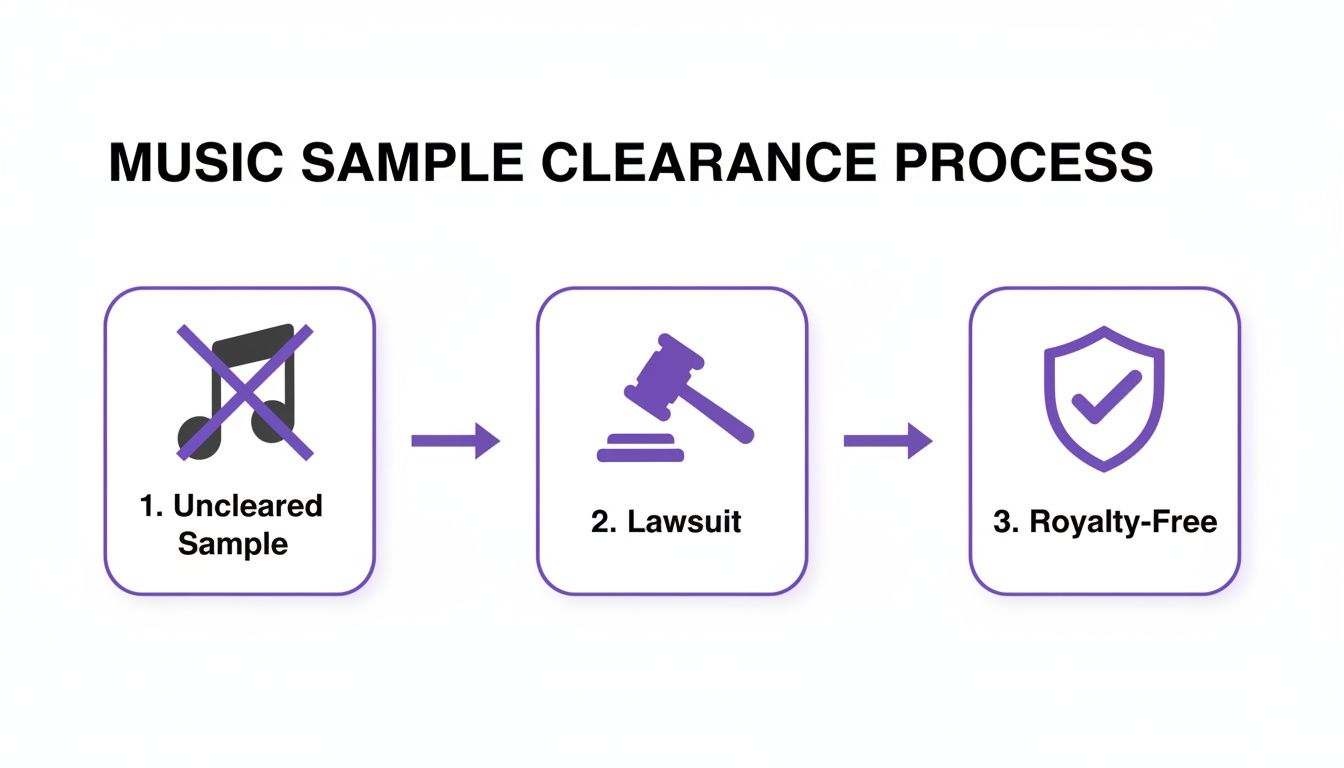
The message is clear: using uncleared samples can land you in serious legal trouble, while royalty-free samples give you a green light to release your music without worry.
Unlocking Melodies with the Piano Roll
So what happens when you have a killer melody in your head but can’t find the right loop? That’s the perfect time to use MIDI, and the Piano Roll is your best friend for editing it. When you drag a MIDI file onto an instrument channel, it pops up in the Piano Roll, showing you all the notes on a grid.
This is where you get total creative control. You can move notes around, tweak their timing, or even write a completely new melody from scratch. The Piano Roll lets you transform a generic MIDI file into a custom performance that fits your beat perfectly.
Using a Construction Kit is like getting a behind-the-scenes look at how a professional track is made. You get all the individual stems—drums, bass, melodies—so you can see exactly how the producer layered everything to create the final mix. It’s an amazing shortcut for learning arrangement.
By following these core steps—building drums in the Channel Rack, arranging in the Playlist, and fine-tuning melodies in the Piano Roll—you have a clear roadmap from an empty project to a fire beat. For an even deeper dive, check out our complete guide on making beats with FL Studio, where we break these techniques down even further.
Unlocking Unlimited Creativity with FL Studio Sound Packs
In music production, your workflow is everything. Every minute you spend digging through folders for the right snare or a decent melody is a minute you’re not finishing a track. For any producer trying to make a name for themselves, efficiency and quality aren’t just nice-to-haves—they’re how you survive.
This is the exact problem FL Studio Sound Packs was built to solve. Instead of the old, expensive model of buying individual packs one at a time, this platform flips the script. You get unlimited access to a massive, professionally curated library for a single price. Think of it like switching from buying MP3s to getting a Spotify subscription for your entire sound arsenal.
A Library Built for Hip Hop Producers
These aren’t just random collections of sounds. They’re purpose-built for specific genres, with exclusive series designed for the sounds of modern hip hop and trap. You can jump into collections like ‘Platinum Swagg’ for chart-ready melodic vibes or ‘City Bangaz’ for drums that hit hard.
This focused approach means you spend way less time searching and way more time creating. The library is stacked with all the essential samples for hip hop you could possibly need:
- Construction Kits: These kits are a cheat code. They give you all the individual stems of a full beat, letting you quickly arrange something new or just study how professional tracks are put together.
- MIDI Files: Having the MIDI gives you total creative control. You can change melodies, swap out instruments with your own VSTs, and completely make a sound your own.
- Industry-Standard Format: Every sound comes as a high-quality .WAV file, so you’ll have zero compatibility issues with FL Studio or any other DAW.
The real game-changer is having a toolkit that’s always growing. New sounds are added all the time, keeping your production palette fresh so you can avoid creative ruts and stay on top of new trends.
Having commercially viable tools at your fingertips is more important than ever. Despite chatter about market saturation, hip-hop continues to flex its commercial muscle. After a small dip, the genre made a huge comeback in 2024, with its average market share on the USA Spotify Top 50 Chart hitting 34%. This proves the demand for high-quality, accessible sounds is only getting stronger. Discover more insights about hip-hop’s 2024 resurgence and what it means for producers.
Streamline Your Workflow and Stay Inspired
At the end of the day, the goal is to remove anything that gets in the way of you making music. By providing a deep, all-access library of royalty-free sounds, FL Studio Sound Packs gets rid of several major headaches for producers. You can stop worrying about legal issues, quit wasting money on single packs, and finally have a reliable source for fresh ideas.
It’s an ecosystem designed to help you make more music, faster, and at a higher quality. For a closer look at the tools waiting for you, check out the dedicated collection of FL Studio Sound Packs for hip-hop and see for yourself how it can change your beats. This approach gives you the creative firepower to not just make tracks, but to build a catalog of competitive, release-ready music.
Common Questions About Hip Hop Samples
As you get deeper into making hip-hop, a few key questions always pop up. It’s totally normal. Getting a handle on these things early on will save you a ton of headaches and help you build a solid workflow from the start. Let’s clear up some of the most common hurdles producers run into.
Can I Use Samples from Any Song If I Change Them?
The short answer? No, not unless you want to get into serious legal trouble.
Chopping, pitching, or drowning a copyrighted sample in effects does not make it yours. To use it legally, you have to “clear” it with the original copyright holders. Trust me, that’s a process that’s almost always expensive and incredibly complicated.
The only way to stay 100% safe and keep your peace of mind is to stick with royalty-free samples for hip hop. Using sounds from services that have already pre-cleared everything for commercial use is the smart move.
Remember this: If you can still recognize the original sound, no amount of processing makes it legally yours without getting permission from the owners first.
What Is the Difference Between a Sample Pack and a Construction Kit?
Think of a sample pack as your pantry full of raw ingredients. It’s a big collection of individual sounds—drum one-shots, melodic loops, vocal chops, you name it. These are the building blocks you use to cook up a track from scratch, giving you total creative control.
A construction kit, on the other hand, is more like a meal-prep kit. It gives you folders, and inside each one are all the individual stems (the separate bass, drums, melody, etc.) for a complete song idea. Construction kits are amazing for learning how songs are arranged and for getting a professional-sounding track together fast when you’re short on inspiration.
Do I Need Expensive Plugins to Make My Samples Sound Good?
Absolutely not. It’s a common myth. While fancy third-party plugins can be fun, the stock tools in FL Studio like Fruity Parametric EQ 2 and Fruity Limiter are more than powerful enough to get the job done.
Honestly, knowing how to use these built-in effects inside and out is way more important than dropping cash on expensive software. The real secret is developing a good ear for sound selection and mastering the fundamental processing techniques—all of which you can do with the tools you already own.
Ready to stop searching and start creating? FL Studio Sound Packs gives you unlimited access to a massive library of 100% royalty-free sounds, MIDI, and construction kits for one single price. Explore the full catalog and find your sound today.