
How to Write a Song Structure That Gets Your Music Heard
Knowing how to write a song structure is all about creating a compelling journey for your listener. Think of it as arranging foundational sections—like verses, choruses, and hooks—into an arc that builds tension and delivers a memorable payoff, keeping your audience locked in from the first beat to the last.
The Anatomy of a Modern Hit Song Structure
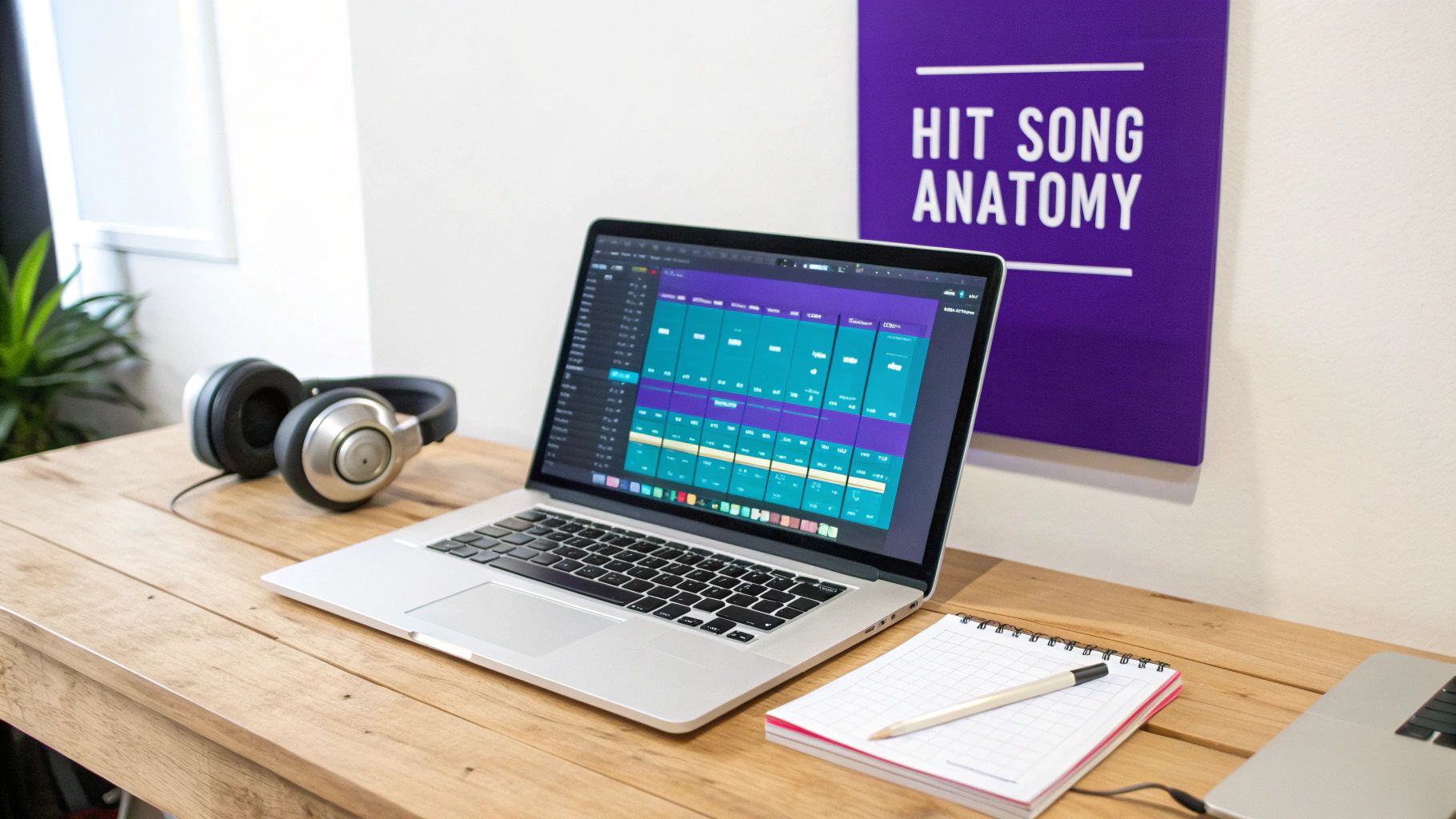
Forget the rigid, textbook formulas you might have learned in music theory class. In today’s streaming-driven world, a song’s structure has one primary job: grab a listener’s attention immediately and don’t let go.
While the classic building blocks still exist, their roles have definitely evolved. Don’t think of them as a strict checklist, but more like a flexible toolkit for crafting an emotional experience. Your goal is to use these sections strategically—a verse shouldn’t just tell a story; it should build anticipation for the release you get in the chorus. A pre-chorus is the ramp that lifts the energy right before the song’s biggest moment. That dynamic push-and-pull is everything in modern production.
The Core Building Blocks
At its heart, every track is built from a few key parts. Once you understand what each one is supposed to do, arranging them becomes a creative game instead of a chore.
Let’s break down the essential parts of a song, what they’re for, and how to make them pop in a world where attention is scarce.
Core Song Sections and Their Modern Purpose
| Song Section | Primary Function | Modern Production Tip |
|---|---|---|
| Intro | Hook the listener instantly. | Keep it short—4 to 8 bars max. Use a unique sound, a vocal chop, or a sliver of the main melody to make it memorable from the first second. |
| Verse | Tell the story and provide context. | This is where you build the foundation. Keep the energy slightly lower than the chorus to create dynamic contrast. |
| Pre-Chorus | Build tension and signal the chorus. | Use rising percussion (like an accelerating hi-hat roll), a new chord, or a filter sweep to create a sense of lift. |
| Chorus/Hook | Deliver the main message and melody. | This needs to be the catchiest, most repeatable part of your song. Make sure the melody and lyrics are simple and powerful. |
| Bridge | Offer a change of pace or perspective. | Create a complete shift in mood. Drop out the drums, change the key, or introduce a new synth pad to give the listener’s ears a break before the final chorus hits. |
| Outro | Conclude the song memorably. | Instead of a simple fade-out, try looping a key vocal phrase or melodic element. This can encourage an immediate replay. |
Understanding how these sections flow into one another is what separates a good beat from a great one. The interplay is crucial. For a deeper dive, check out our guide on the art of beat making.
Adapting to the Modern Listener
The structure of popular music is always shifting, and right now, social media is the biggest driver of that change. In fact, research shows that traditional song elements are changing fast in chart-topping tracks. The bridge has almost completely disappeared from many modern hits, and you’ll even see the second verse get cut short so the artist can get back to the chorus faster. You can find some fascinating insights on how platforms like TikTok are rewriting the rules of pop on berklee.edu.
Your song structure isn’t just a blueprint; it’s a strategic tool for listener retention. In an era of short attention spans, the first 15 seconds often determine whether someone listens to the full track or just swipes to the next one.
Ultimately, mastering song structure means learning the rules just so you know how to break them with purpose. When you get what each section is meant to achieve, you can arrange, rearrange, and adapt them to create a track that feels fresh, dynamic, and perfectly built for today’s audience.
Arranging Your Music for Streaming and Social Media

Ever find yourself scrolling through TikTok, wondering why a certain track is absolutely everywhere while yours gets lost in the noise? The secret sauce is almost always the arrangement. Knowing how to write a song structure for modern platforms isn’t just about making good music—it’s about engineering moments that are built to go viral.
To win in today’s music world, you have to think more like a content creator than a traditional producer. It’s a total mindset shift. Forget the slow, cinematic build-up; you need an immediate hook that snags a listener’s attention in the first three seconds. Punchy choruses and perfectly loopable sections aren’t just nice additions anymore. They’re your survival kit.
Pinpoint Your Viral Moment
Before you even think about laying out your track, listen to your core idea. Is it a killer loop, an infectious vocal chop, or a standout melody? Ask yourself one crucial question: What’s the most compelling 15-second clip in this entire idea? That little piece of audio gold is your ticket.
Once you’ve found it, your entire song structure needs to be built around showcasing that moment. Every single section, from the verse to the bridge, should either be setting up that viral clip or providing a powerful follow-up. This “front-loading” strategy—hitting them with your best idea early and often—is absolutely critical.
And this isn’t just a hunch; the data screams it. TikTok has become the undeniable launchpad for global hits. It’s wild, but an incredible 96% of songs that landed on Billboard’s Global 200 chart last year first blew up on the platform. If you want to dive deeper, check out this insightful music business analysis for more on this trend.
Build for the Algorithm
The algorithms on platforms like TikTok and Instagram Reels are designed to push content that keeps people watching. Your song’s structure can play directly into their hands.
- Create Perfect Loops: Design your main hook or chorus so it feels completely seamless when it repeats. A track that loops smoothly encourages people to watch again and again, which is a massive signal to the algorithm that your content is a winner.
- Front-Load the Energy: Get your main hook or drop in there within the first 15-30 seconds. This makes sure even the most casual scroller gets hit with the most exciting part of your song right away.
- Structure Around a Trend: Pay attention to the audio clips that are trending. You’ll often notice a clear “setup and punchline” dynamic. You can mimic this in your arrangement by using a quieter verse to build anticipation right before a massive chorus explodes.
Don’t be afraid to give away your best idea right at the start. In the streaming economy, you don’t have the luxury of a slow burn. Your job is to create an undeniable moment that makes someone stop scrolling, save the audio, and use it in their own video.
This is where tools like the loops and MIDI files from FL Studio Sound Packs become a massive advantage. You can quickly drag and drop different melodic ideas and drum patterns to prototype these attention-grabbing moments. Found a MIDI progression that feels instantly catchy? Build your entire track around that foundation, knowing it’s already primed for impact.
Practical Song Structure Frameworks By Genre
Every genre has its own pulse. A hypnotic house track builds energy in a totally different way than a hard-hitting trap anthem, and getting a feel for these unspoken rules is the key to making music that connects.
Think of these less as rigid rules and more as proven starting points. They’re built on years of listener expectations. Let’s move from theory to practice and break down the frameworks for today’s biggest genres, looking at the “why” behind their common arrangements. Once you get these down, you’ll have the freedom to bend and break the rules with purpose.
The Modern Pop Blueprint
Modern pop is all about one thing: maximum impact, fast. The structure is lean and mean, designed to get to the hook as quickly as possible and drill it into the listener’s head. There’s almost no fat to trim—every single section exists to lift up that main chorus.
A typical, radio-ready pop structure usually unfolds something like this:
- Intro (4 bars): Just a taste—maybe a vocal chop or a snippet of the main synth to grab attention immediately.
- Verse 1 (8 bars): Sets the scene and tells the story, usually with a bit less energy.
- Pre-Chorus (4-8 bars): The ramp-up. You can feel the tension building here, letting you know the big moment is coming.
- Chorus (8 bars): This is the payoff. High energy, the most memorable melody, and the core message of the song.
- Verse 2 (8 bars): New lyrics, same melodic vibe as the first verse to keep things familiar.
- Pre-Chorus (4-8 bars): That same lift, building anticipation for the chorus again.
- Chorus (8 bars): Driving the hook home a second time.
- Bridge (8 bars): A change of pace. The instrumentation often thins out, offering a new perspective lyrically or musically.
- Chorus (16 bars): The grand finale. This one is often doubled, loaded with ad-libs and extra layers to feel huge.
- Outro (4 bars): A quick fade, often just looping the hook one last time.
This formula works so well because it never lets you forget the most important part of the song: the chorus.
The Hip-Hop and Trap Formula
Trap and modern hip-hop are often built around a single, powerful loop—usually an 8-bar phrase that becomes the entire foundation of the track. The arrangement isn’t so much about telling a long, evolving story as it is about creating a hypnotic, hard-hitting vibe for the vocalist to ride.
Intros are short and sweet, often just 4 bars to get right to the action. From there, the hook is king, showing up after every single verse to keep the energy locked in. Bridges are pretty rare in this world. Instead, you’re more likely to hear a breakdown where the drums and bass drop out for a few bars, creating a pocket of space before everything comes crashing back in.
Producer Tip: A go-to trap arrangement is Intro – Chorus – Verse – Chorus – Verse – Chorus – Outro. This structure is relentless. It keeps the main idea front and center, which is perfect for grabbing and holding attention in the fast-paced world of streaming.
It’s no secret that streaming has taken over the music industry, now accounting for 84% of recording revenues in markets like the U.S. This shift has definitely favored genres like trap that deliver that instant hit. You can get more details on how streaming dominates the U.S. music market and see how it’s shaping the music we hear.
The House and EDM Journey
Unlike pop and trap, house music is all about the journey. These tracks are built for the dancefloor, designed to create a hypnotic state by building and releasing tension over long stretches. Extended intros and outros, often 16-32 bars long, are the norm. This gives DJs plenty of room to smoothly mix one track into the next.
The whole arrangement revolves around the drop—that magical moment when the full beat and bassline finally kick in after a long, suspenseful buildup. Forget verses and choruses; it’s better to think in sections defined by adding or subtracting layers to manipulate the energy. For any producer just getting started, mastering these core concepts is essential. We’ve actually got a full walkthrough in our guide to house music production with FL Studio.
To help visualize these differences, here’s a quick comparison of the common structures we’ve covered.
Song Structure Comparison by Genre
| Genre | Common Structure | Key Characteristics |
|---|---|---|
| Hip-Hop/Trap | Intro – Hook – Verse 1 – Hook – Verse 2 – Hook – Outro | Short sections, hook-driven, minimal changes, focuses on a core loop. |
| Pop | Intro – Verse 1 – Pre-Chorus – Chorus – Verse 2 – Pre-Chorus – Chorus – Bridge – Chorus – Outro | Fast to the chorus, high repetition of the main hook, clear tension and release. |
| House | Intro – Buildup – Drop – Main Section – Breakdown – Buildup – Drop 2 – Outro | Long intros/outros for mixing, energy builds over time, focuses on the “drop”. |
As you can see, each genre prioritizes something different. Hip-Hop wants you nodding your head immediately, Pop wants you singing along by the second chorus, and House wants to take you on a long, immersive ride. Understanding these foundational blueprints is the first step toward creating authentic tracks that resonate with listeners.
Building Your Song Structure in FL Studio
Theory is one thing, but the real magic happens the moment you drag your first sound into the Playlist. This is where your track’s skeleton really starts to take shape. Honestly, learning how to write a song structure in FL Studio is all about workflow—using the DAW’s built-in features to get your ideas organized fast so you can stay creative.
The goal is to map out your sections visually. That way, you can focus on making music, not on project management. Let’s get practical and turn that messy folder of loops and half-baked ideas into a fully arranged beat.
Mapping Your Sections with Markers
Before you even think about adding a Pattern, give your song a roadmap. FL Studio’s Markers are absolutely perfect for this. They let you label different parts of your timeline, creating a visual guide that keeps you from getting lost in a sea of empty bars.
It’s dead simple. Just go to the spot on your timeline where a new section should start, press Alt+T, and type in the name. In seconds, you’ve transformed a blank grid into a structured project.
Try mapping out a basic pop or hip-hop arrangement to get started:
- Intro (Bars 1-5): This is your first chance to grab the listener.
- Verse 1 (Bars 5-21): Time to start telling your musical story.
- Chorus (Bars 21-29): The main event, where the energy should hit its peak.
- Verse 2 (Bars 29-45): Keep the narrative going with new ideas.
- Chorus (Bars 45-53): Bring back that main hook to make it stick.
- Outro (Bars 53-61): End the track on a memorable note.
Just like that, you have a clear, visual framework. Now, instead of guessing where your sounds should go, you’re just filling in the blanks.
Leveraging Sound Packs for Rapid Arrangement
This is where your library of sounds, especially high-quality FL Studio Sound Packs, becomes your greatest asset. Think of them less as just folders of samples and more as arrangement cheat codes.
Construction Kits are a goldmine for understanding how a professional track is put together. Drag all the stems from a kit right into your new marker-based layout. Pay attention to how the pros layer their drums, bass, and melodies to build energy from a verse into a chorus. You can literally reverse-engineer their structure and then start swapping out their sounds with your own.
MIDI files offer another massive shortcut. Find a MIDI progression you like, drag it onto one of your synth channels, and boom—you have a professional-sounding chord progression or melody ready to go. This can form the entire harmonic foundation for your track without you needing to play a single note.
Producer Tip: Don’t just drag and drop loops and call it a day. Chop them up, pitch-shift them, and reverse them to make them your own. Knowing how to use samples in FL Studio effectively is what separates the beginners from the pros. It’s how you develop a unique sound while still taking advantage of the speed that pre-made loops offer.
Color Coding for Clarity
Once you start adding Patterns, your Playlist can get messy, fast. A simple but incredibly powerful habit to get into is color-coding your Patterns by instrument type. Just right-click a Pattern in the Picker Panel, select “Rename and color,” and assign colors that make sense to you.
A common system I see (and use) looks something like this:
- Drums: Red
- Bass: Blue
- Melodies/Synths: Green
- FX/Transitions: Yellow
This visual system lets you see your entire arrangement at a glance. You can instantly spot if your chorus is missing the bassline or if your verse feels a bit empty and needs more melodic elements. It’s a small step that saves a massive amount of time and mental energy, keeping you locked in a creative flow state.
Combine these three techniques—markers, sound packs, and color-coding—and you’ll have a powerful, intuitive workflow for structuring tracks every single time.
Advanced Techniques for Dynamic Arrangements
Let’s be real: a great song structure is about creating an emotional journey, not just lining up colored blocks on a timeline. Once you’ve moved beyond the basic intro-verse-chorus layout, the real goal is to make your arrangements feel dynamic, alive, and unpredictable.
This is where you master the art of the transition and understand that what you take away is often more powerful than what you add. These are the details that separate a good track from a truly great one. By focusing on movement, contrast, and subtle changes, you can transform a repetitive loop into a compelling story that keeps the listener hooked from the first beat to the last.
The process doesn’t have to be complicated. I’ve found a simple three-step workflow keeps things organized without killing the creative vibe.
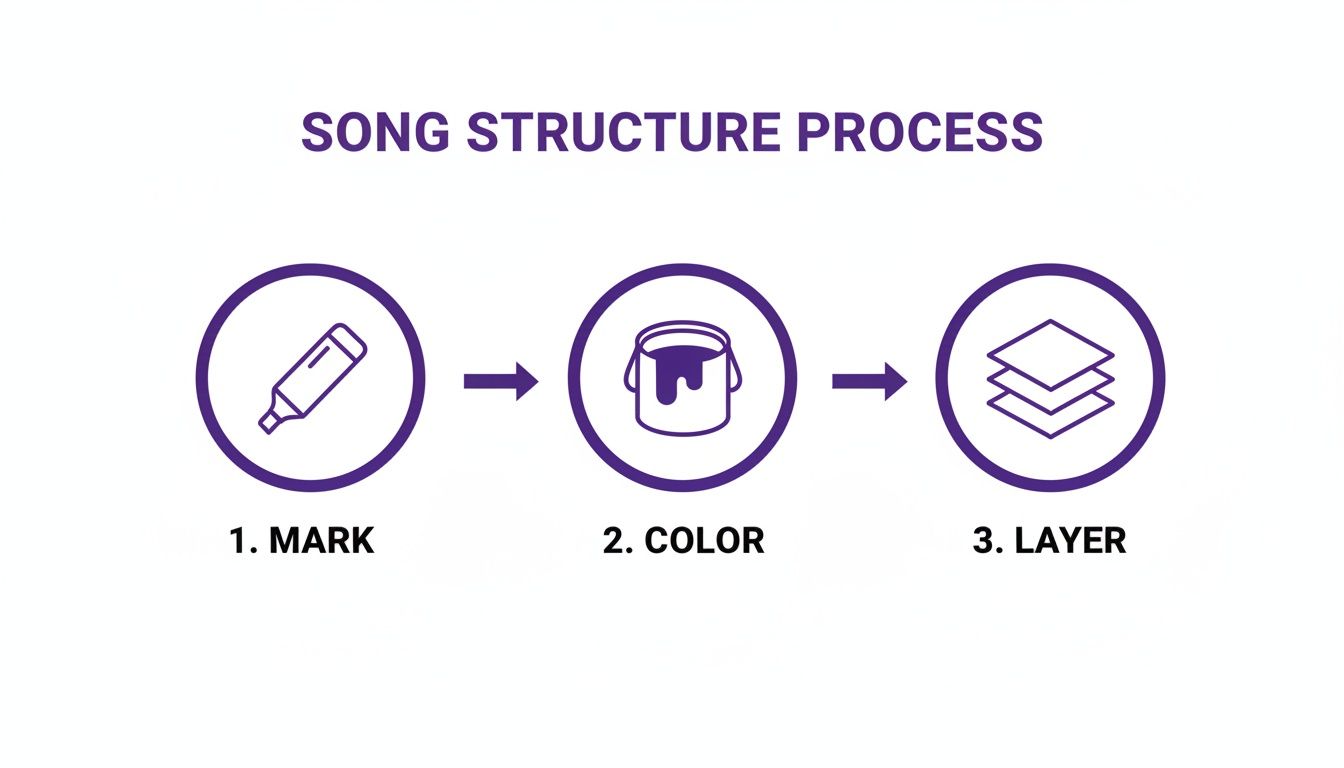
This approach is all about structure: first, you mark out your sections, then you color-code them for a quick visual reference, and finally, you layer in the sounds to build complexity and energy where it’s needed most.
The Power of Subtraction
One of the single most effective ways to make a section hit harder is to create a moment of near-silence right before it drops. Strategically removing elements—a technique we call subtraction—is a pro move for building insane anticipation. Just think about the last bar before a massive chorus; cutting the drums and bass makes their return feel absolutely huge.
This trick creates an energy vacuum that makes the payoff incredibly satisfying. You can use this idea everywhere:
- Right before a drop: Kill everything except for a riser and maybe a ghostly vocal chop.
- To freshen up a second verse: Try muting the main synth melody to give the vocals more room to breathe.
- In a bridge: Drop the percussion entirely and let some atmospheric pads or strings take over the space.
Mastering Your Transitions
Seamless transitions are the glue that holds your entire track together. Instead of just slamming two sections against each other, you need to gently guide the listener’s ear from one part to the next. This is where FX and a little bit of “ear candy” come into play.
- Risers and Sweeps: These are classics for a reason. Use a white noise sweep to build tension into a chorus or a downlifter to smoothly exit one. Simple, but it works every time.
- Drum Fills: A quick one-bar drum fill is a universal signal that a change is coming. It breaks the main rhythmic pattern just long enough to reset the listener’s expectation.
- Reverse Cymbals: This is a producer favorite. Place a reversed crash cymbal so its peak lands exactly on the downbeat of the new section. It creates a “swoosh” effect that literally pulls the listener forward into the next part of the song.
A common mistake is making every transition a massive event. Sometimes, the most effective transitions are the subtle ones. Try automating a low-pass filter to slowly open up over four bars, gradually revealing the high frequencies of the next section’s main synth. It’s a much smoother and more professional way to build energy.
Avoiding the Robotic Loop
Even the catchiest loop in the world gets boring if it just repeats over and over without any change. To keep repeated sections like your verses or choruses feeling fresh, you need to introduce subtle variations. The goal isn’t to rewrite the whole part, but to add tiny details that reward people for listening closely.
For instance, the second time the chorus hits, you could try a few small things:
- Add a quiet harmony floating underneath the main vocal line.
- Introduce a new percussion element, like a shaker or a different hi-hat pattern.
- Slightly tweak the synth’s filter cutoff using automation to give it a little more bite.
These small additions are what prevent listener fatigue. They make your arrangement feel like it’s constantly evolving, turning a solid idea into a professional-sounding track and ensuring your song structure supports a dynamic, captivating experience from start to finish.
Your Top Song Structure Questions, Answered
Figuring out the “rules” of song structure can feel like trying to hit a moving target, especially when what’s popular seems to shift every few months. Let’s clear up some of the most common questions producers run into when mapping out their tracks.
How Long Should My Song Be for Streaming?
If you’re aiming for streaming success, the magic number is usually somewhere between 2 minutes 30 seconds and 3 minutes 30 seconds. This gives you enough time to develop your ideas without letting the track drag on and lose your listener.
Think about it from a platform perspective. Shorter songs get replayed more often, and that’s a huge metric on places like Spotify. The single most important rule? Get to the hook or main idea within the first 30 seconds. In today’s attention economy, long, drawn-out intros are a surefire way to get skipped.
What’s the Go-To Structure for Pop Music?
The blueprint that has ruled the charts for years is the classic Verse – Pre-Chorus – Chorus – Verse – Pre-Chorus – Chorus – Bridge – Chorus – Outro. There’s a reason this formula works so well—it’s all about building anticipation and delivering a massive, memorable payoff with the chorus.
That said, modern pop is all about efficiency. You’ll hear tons of hits today that cut out the bridge or even the second verse entirely. The goal is to get back to that undeniable, unforgettable chorus as quickly and as often as possible.
Start by locking in your best chorus. Once you have that core identity for the song, every other section—verses, bridges, intros—simply becomes a way to support and lead into that main event. It makes the entire arrangement process so much more focused.
How Can I Make My Transitions Sound Less Abrupt?
Making your transitions feel natural is all about giving the listener cues. Instead of just slamming one section into the next, you need to artfully manage the energy and guide their ear.
Try using these tools to signal that a change is on the way:
- Drum Fills: A classic one-bar fill is the perfect way to break up a repetitive beat and signal “here comes the chorus!”
- Risers & Sweeps: You can’t go wrong with a white noise sweep to build tension right before a big drop or chorus.
- Filter Automation: Smoothly opening up a low-pass filter on a synth pad or lead is a great way to gradually introduce a new section.
One of my favorite tricks is to pull the bass and drums out for just a beat or two right before the chorus hits. This creates a pocket of silence that makes the impact feel ten times bigger when everything comes crashing back in.
Ready to stop endlessly searching for sounds and get back to creating? FL Studio Sound Packs give you instant access to a massive, royalty-free library of loops, MIDI, and full construction kits designed to speed up your workflow.
Explore the entire catalog and find your next hit sound now.