
Your Essential Guide to the Modern 808 Drum Kit
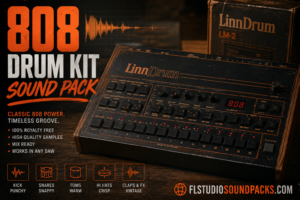
An 808 drum kit is more than just a folder of audio files—it’s a direct line to the sound that has defined modern music for decades. These kits are packed with the iconic sounds of the legendary Roland TR-808 Rhythm Composer, especially its deep, booming bass drum that has become the absolute foundation for genres like trap and hip-hop.
What Is an 808 Drum Kit, and Why Is It So Iconic?
Think of the original Roland TR-808 as a rare, vintage piece of hardware with a distinct, analog soul. A modern 808 drum kit is the digital evolution of that legend—a sample pack that puts those same legendary sonics right into your DAW.

When you load up a kit from a library like FL Studio Sound Packs, you’re not just getting a copy; you’re getting a perfectly engineered digital instrument that captures the 808’s DNA while offering the infinite flexibility modern production demands.
From Commercial Flop to Cultural Phenomenon
The journey of the 808 is one of music’s greatest underdog stories. When the Roland TR-808 launched back in late 1980, it was met with a pretty lukewarm reception. Producers at the time thought its synthesized drum sounds were “unrealistic” compared to expensive, sample-based machines like the Linn LM-1.
It originally sold for $1,195—which is about $4,560 in today’s money. Despite its innovative design, it was a commercial flop. Roland only made around 12,000 units before pulling the plug in 1983. You can get the full rundown on the TR-808 Wikipedia page.
But that failure was a blessing in disguise. By the mid-80s, you could find secondhand 808s in pawn shops for under $400, making them accessible to a new wave of producers working on tight budgets. Hip-hop and electronic music pioneers snatched them up, drawn to that unique and powerful low-end, and started building a whole new sonic language.
The 808’s affordability on the second-hand market directly fueled its adoption in early hip-hop. What was once seen as a flaw—its “unrealistic” sound—became its greatest strength, offering a futuristic and powerful alternative to acoustic drums.
The Sound That Defined Modern Music
From those humble beginnings, the 808’s influence just exploded. Its sound became the backbone of countless hits and entire genres. So what makes it so special?
- The Booming Bass: The 808 kick isn’t just a kick; it’s a long, sustained sub-bass tone that you can actually tune and use to write basslines.
- Crisp Percussion: Its sharp claps, snappy snares, and metallic hi-hats have a unique character that cuts right through any mix.
- Pure Synthesis: Unlike sampled acoustic drums, the 808’s sounds were generated by analog circuits. This gave them a warm, clean, and purely electronic quality that was impossible to replicate.
Fast forward to today, and its legacy is undeniable. One study found that 808 bass drums were used in an incredible 60% of Billboard Hot 100 hip-hop songs between 2010 and 2020. That one sound has become the very heartbeat of trap, modern R&B, and pop, cementing the 808’s place in history as an accidental icon.
Decoding The Core Sounds Of Your 808 Drum Kit
An 808 drum kit is so much more than just that legendary bass. If you really want to master it, you have to get to know the unique personalities of its core sounds and the specific jobs they do on a track. Think of it like a painter’s palette—sure, the deep black is essential, but it’s the other colors that truly bring the canvas to life.
We can break down the most important sounds in any quality 808 drum kit into three main families. Each one serves a distinct purpose, whether it’s laying down a melodic foundation or driving the raw rhythmic energy of your beat. Getting a handle on these categories is your first step toward making smarter creative choices.
The Melodic Foundation: The 808 Sub-Bass
This is the sound everyone thinks of when they hear “808.” It’s that long, sustained sine wave with a subtle click right at the beginning. Its defining feature is its deep, resonant sub-frequency content—the kind of bass you feel in your chest more than you hear with your ears, especially on a good sound system.
The sub-bass 808 isn’t just another drum; it’s a full-on bass instrument. Producers lean on its long decay to write melodic basslines that anchor the entire harmonic structure of a song. Its pure, clean tone adds immense weight and power without muddying up the mix, making it the perfect low-end foundation.
The Rhythmic Driver: The Punchy 808 Kick
While the sub-bass handles the melody, the punchy 808 kick delivers the gut punch. This sound has a much shorter decay and a sharper, more defined “click” at the front. Its job isn’t to hold a note but to land a quick, percussive hit that slices through even the most crowded mix.
An 808 sub-bass creates the emotional weight and melodic movement in the low end. In contrast, the punchy 808 kick acts like a battering ram, providing the rhythmic force that makes people want to move.
Imagine you’re building a house. The sub-bass is the deep, solid concrete foundation, while the punchy kick is the structural frame that gives the building its shape and rhythm. You really need both for a solid build. In fact, many producers layer these two sounds to get the best of both worlds: the immediate attack of the kick and the sustained weight of the sub.
The Sonic Chameleon: The Processed and Distorted 808
Modern music, especially genres like trap and experimental electronic, has pushed the 808 way beyond its original clean sound. This third family covers all the 808s that have been mangled with effects like saturation, distortion, and aggressive filtering. These tweaks add harmonic complexity, grit, and a ton of unique character.
A processed 808 is the wild card in your toolkit. It can be a gritty, distorted monster that becomes the aggressive centerpiece of a beat, or it can be a subtly saturated tone that adds warmth and helps the bass cut through on smaller speakers like laptops and phones. That versatility makes it an indispensable tool for any producer trying to carve out a unique sonic identity.
Choosing Your 808 Sound Type
To help you decide which sound to grab when you’re in the creative zone, think of it this way: are you writing a bassline, punching up the rhythm, or adding attitude? Each type has its place.
This table breaks it down to make the choice even clearer.
| 808 Sound Type | Key Sonic Characteristic | Primary Use Case | Example Genres |
|---|---|---|---|
| 808 Sub-Bass | Long decay, deep sub-frequencies, clean tone | Creating melodic basslines, providing foundational weight | R&B, Modern Pop, Hip-Hop |
| Punchy 808 Kick | Short decay, sharp transient, percussive attack | Driving the rhythm, cutting through a dense mix | Classic Hip-Hop, House, Pop |
| Processed 808 | Saturated, distorted, harmonically rich | Adding aggression, character, and mix presence | Trap, Drill, Dubstep, Experimental |
Once you understand these three core sound types, you can stop just dropping random samples into your project. Instead, you can intentionally pick the perfect 808 from your drum kit to get the exact emotional and rhythmic impact your track is calling for.
Matching Your 808 Drum Kit to Your Genre
Choosing the right 808 drum kit is like casting the main character in a movie—the entire production’s vibe hangs on that decision. The sound you pick instantly sets the tone for the genre, and a mismatched 808 can make an otherwise solid track feel completely off. Nailing this first step is everything if you want to build a believable sonic world for your music.
Luckily, it’s simpler than you might think. It all starts with knowing what your genre demands from its low end. This chart gives you a clear visual path for sorting 808s by their job in a track, helping you figure out if you need a deep sub, a punchy kick, or something with more grit.

As the flowchart shows, each type of 808 leads down a different musical road. This isn’t about grabbing a random sample; it’s a strategic choice. Let’s break down which sounds belong to which genres.
Trap and Modern Hip Hop
In trap music and its endless subgenres, the 808 isn’t just part of the rhythm section—it is the lead instrument. This style is all about 808s with a long, booming decay and tons of harmonic character, which is why distorted and saturated samples are king. These processed sounds have the bite to cut through a busy mix, even on laptop speakers.
The real test for a trap 808 is its ability to be played like a synth. You need a sample that can hold a note long enough to create those iconic slides and memorable basslines. A clean sub-bass can sometimes do the job, but it’s the distorted 808s that deliver the aggressive, in-your-face attitude the genre is known for.
In trap, the 808 slide is non-negotiable. It’s the sonic signature that creates tension and release, turning a simple bassline into an infectious hook. Choose a sample with a long tail to give your slides room to breathe.
Look for an 808 drum kit that’s packed with different saturated textures. Kits like ‘City Bangaz’ from FL Studio Sound Packs are built for this, giving you sounds that are already beefed up and ready for the slides and glides that define trap. For a deeper dive, check out our guide on trap drum kits and sound packs.
Classic Hip Hop and Boom Bap
Classic hip-hop and boom bap are built on a totally different foundation: pure punch and groove. In these styles, the 808 acts more like a traditional, heavyweight kick drum than a melodic bass. The mission here is simple: find a clean, punchy sound that hits hard and then gets out of the way.
You’ll want to hunt for 808 kick samples with a sharp attack and a short decay. These kinds of sounds give you the weight you need without muddying up the low end, leaving plenty of room for a funky bassline or other melodic samples. That classic, head-nodding boom bap beat? It’s often just a punchy 808 layered with a snappy snare.
This genre-defining power isn’t new. The 808’s kick became the heartbeat of early hip-hop, and by the ’90s, its sounds were in an estimated 85% of rap records. Today, its legacy is stronger than ever, with 90% of top SoundCloud trap uploads using 808 slides and BeatStars reporting that 75% of their top-selling trap beats are built with 808 kits. You can get the full story in this deep dive on the 808 bass sound.
House and Electronic Music
In house, techno, and other four-on-the-floor genres, the kick drum is the relentless pulse of the track. While an 808 isn’t always the first choice, a well-placed one can add incredible depth and power. The trick is to use it with surgical precision, so it beefs up the groove instead of washing it out.
For these genres, grab a short, tuned 808 kick. “Tuned” is the keyword here—the 808 has to be in key with your track to prevent weird harmonic clashes. A short decay is just as important, making sure it doesn’t bleed into the next kick and turn your low-end into a muddy mess.
Here are a few quick tips for using 808s in electronic music:
- Layering: Tuck a short 808 kick underneath your main kick to add some serious sub-frequency power.
- Off-Beat Bass: Use a tuned 808 to create a simple, syncopated bassline that plays off the main kick pattern.
- Control the Decay: Always use your sampler’s envelope to tighten up the 808’s tail, keeping it short and punchy.
By matching the right sound from your 808 drum kit to what your genre needs, you’re laying down an authentic foundation that makes every other element in your track sound better.
Essential Production Techniques for Powerful 808s
Having a great 808 drum kit is only half the battle. The real magic happens when you know how to make those sounds punch, sit right, and drive your track forward. Without the right touch, even the best samples can sound weak or muddy, getting lost in the mix.
This is where you graduate from just having sounds to actually producing them—transforming a raw sample into the solid, professional low-end that defines your beat.

These core techniques aren’t just optional extras; they’re the essential skills every serious producer needs. Nail these, and you’ll immediately hear the difference in your tracks, ensuring your 808s hit hard every single time.
Tune Your 808s to the Song Key
One of the biggest mistakes new producers make is treating a melodic 808 like a regular drum. It’s not. That 808 sub has a real, distinct pitch, and if it’s out of tune with your melody or chords, your whole track will sound dissonant and amateurish. Tuning isn’t a suggestion—it’s a requirement.
Think about it this way: you wouldn’t let your synth lead play in the wrong key, so why let your 808? The fix is simple. Use a spectrum analyzer or tuner plugin to find the root note of your 808 sample, then pitch it up or down until it lines up with the key of your song. This one step is crucial for making your track sound harmonically glued together.
Layer Your 808 with a Punchy Kick
While some 808s come with a built-in click, many of the best sub-bass samples have a soft attack that can easily disappear in a busy mix. The solution? Layering. By pairing your 808 with a short, punchy kick drum, you get the best of both worlds. The kick delivers that sharp transient that cuts through, while the 808 brings the sustained low-end weight.
Here’s a quick workflow for layering:
- Find Your Sounds: Pick a deep, rumbling 808 sub and a separate kick that has a sharp, clean attack.
- Program the Same Pattern: Make sure the kick and 808 trigger at the exact same time by placing them on the same MIDI notes.
- Carve Out EQ Space: This is key. Use an EQ to cut the low frequencies out of the kick drum. This stops it from fighting with the 808’s sub-bass, giving each sound its own space to shine.
This technique gives you that immediate impact from the kick and the powerful body from the 808, all working together.
Add Warmth and Presence with Saturation
Ever made an 808 that sounds huge on your studio monitors but completely vanishes on a phone or laptop? That happens because small speakers physically can’t reproduce those deep sub-frequencies. The secret weapon here is saturation.
Saturation adds subtle harmonic overtones to the sound, which are higher in frequency and can be heard on smaller speakers. It gives the 808 warmth, grit, and a character that helps it translate across any playback system.
Think of saturation as adding color to a black-and-white image. The original 808 is the deep, powerful black, but saturation adds shades of gray and hints of color, making the entire picture more visible and interesting on any screen.
Try a gentle tape or tube saturation plugin to start. You’ll be surprised how a little bit of harmonic distortion brings your 808 to life, making it a bassline you can not only feel, but also hear.
Control Dynamics with Compression and Sidechaining
Finally, to get that clean, powerful low-end, you have to manage the relationship between your kick and 808 so they don’t step on each other’s toes. Two tools are non-negotiable for this: compression and sidechaining.
- Compression: This helps tame the 808’s volume, smoothing out any wild peaks and making it sit more consistently in the mix. You can also use it to creatively shape the punch and sustain of the 808.
- Sidechaining: This is a classic mixing trick where you make one track’s volume automatically duck in response to another. By sidechaining the 808 to the kick, the 808’s volume will dip for just a millisecond whenever the kick hits.
This tiny dip creates a perfect pocket of space for the kick’s transient to cut through cleanly, preventing frequency clashes and giving you a much tighter, more professional rhythm section. It’s like a polite conversation—the 808 “listens” for a moment when the kick “speaks,” making sure they never talk over each other.
Your FL Studio Workflow for Perfect 808s
Okay, enough with the theory—let’s get our hands dirty inside FL Studio. This isn’t just a list of techniques; it’s a practical roadmap to take any raw 808 from your sound pack and turn it into the heart of your track, using only the tools you already have.
Everything kicks off in the Channel Rack. Think of it as your launchpad. Just find the 808 you want—ideally from a high-quality library like an FL Studio Sound Pack—and drag it straight into the rack. That’s step one.
From there, we jump into the Piano Roll. This is where the magic happens. It’s where you’ll lay down your basslines, write melodies, and program those classic slides that define genres like trap.
Setting Up Your 808 Sample
Once your 808 is loaded, a quick click on its channel name opens up the Sampler window. This is your first and most important stop. Before you even think about adding effects, you need to shape the sound itself using the envelope controls (ADSR).
For 808s, the most crucial knob is DEC (Decay). Tweaking the decay lets you control exactly how long the note rings out, which is key to preventing your bassline from turning into a muddy mess. You’ll also want to hit the “Miscellaneous functions” tab and enable Cut Self. This ensures each new note instantly cuts off the previous one—a non-negotiable for clean, punchy basslines.
Think of the Sampler’s envelope as a sculptor’s chisel. It allows you to carve away the excess, shaping the raw block of sound into a clean, tight, and perfectly timed element that fits your groove precisely.
This level of control is what made the original 808 so special. The machine, pioneered by Roland founder Ikutaro Kakehashi and American innovator Don Lewis, was one of the first to offer editable rhythms. Its bass drum could hit frequencies as low as 30Hz—low enough to blow out speakers back in the day. For us FL Studio producers, this means modern 808 drum kits give us that same editable power, letting us tune it, stretch the decay, and layer it right inside the DAW. You can learn more about the history of the influential 808 drum machine to see just how far the tech has come.
Tuning and EQ with Native Plugins
Now that your 808’s shape is dialed in, it’s time to send it to a mixer track and start processing. The absolute first step here is tuning. An out-of-tune 808 will ruin an otherwise great track.
- Pitcher: Drop an instance of Pitcher on your 808’s mixer track. It will instantly tell you the root note of the sample. If it doesn’t match your song’s key, just head back to the Sampler window and adjust the pitch knob until it’s perfect.
- Fruity Parametric EQ 2: This is your surgical tool. Start with a high-pass filter to gently cut out any useless sub-bass rumble below 30-40Hz. This cleans up your mix and gives you more headroom. If you’re layering your 808 with a kick, you might also want to carve out a small dip around 80-100Hz to give the kick its own space to punch through.
This screenshot shows the powerful Piano Roll interface in FL Studio, where you can program intricate 808 melodies and slides. Notice the detailed grid and note properties, which give you full control over timing, velocity, and pitch for every single 808 hit.
Compression and Sidechaining
Finally, let’s get the dynamics under control and make some space for the kick. Fruity Limiter is perfect for this. Load it onto your 808’s mixer track and immediately switch it from LIM (Limiter) mode to COMP (Compressor) mode.
- Compression: Gently adjust the THRES (Threshold) and RATIO knobs. The goal is to catch the loudest peaks of the 808, making the bassline feel more solid and consistent without squashing the life out of it.
- Sidechaining: Go to your kick drum’s mixer track, right-click the routing arrow at the bottom, and select “Sidechain to this track.” Now, back on your 808’s Fruity Limiter, select your kick as the Sidechain input. Lower the threshold and turn up the ratio until you hear the 808 “duck” out of the way just as the kick hits.
By following this workflow, you can use FL Studio’s own tools to turn any basic sample from an 808 drum kit into a polished, hard-hitting foundation for your beat. If you want to dive deeper, our complete guide on how to use samples in FL Studio will take your skills even further.
Finding High Quality Royalty Free 808 Drum Kits
Sourcing a top-tier, legally clear 808 drum kit is one of the most critical steps for any producer today. The right samples can absolutely make a track, but the wrong ones can unleash a tidal wave of problems that go way beyond just sounding bad. This is where you have to understand the real value of royalty-free sounds.

Let’s be clear: using royalty-free kits is non-negotiable if you ever plan to sell, stream, or get your music out there. It’s your legal green light, confirming you can use the sounds in your commercial projects without owing a dime in future payments to the person who made them. This simple choice protects you from copyright claims, legal headaches, and the nightmare of having your music yanked from platforms.
The Dangers of Unverified Free Kits
The internet is swimming in “free” 808 kits, but grabbing them from random sources is a huge gamble. So many of these packs are just thrown together from who-knows-where and come with serious risks that can completely derail your project.
You’ll run into common headaches like:
- Awful Audio Quality: Samples are often noisy, clipped, or have dead air at the beginning or end. You end up wasting precious creative time on cleanup instead of just making music.
- Mislabeled Files: That 808 says it’s in the key of C, but it’s actually a C#. Suddenly your whole bassline is out of tune, and you’re left wondering what went wrong.
- Hidden Legal Traps: That “free” kit might have fine print buried somewhere that bans commercial use, putting you in a really tough spot if your track blows up.
These issues are more than just annoying; they are creative roadblocks that can seriously compromise the professional quality of your music.
Sourcing your sounds is like a chef sourcing ingredients. Using professionally made, royalty-free samples is like cooking with fresh, high-quality produce. Grabbing random freebies from the web is a gamble that could ruin the entire dish.
The Curated Solution for Producers
This is exactly the problem that a professional library like FL Studio Sound Packs was built to solve. Instead of digging through sketchy downloads, you get immediate access to a massive library of professionally engineered, 100% royalty-free sounds.
Every single 808 drum kit is curated for quality. That means every sample is clean, perfectly tuned, and ready to drop right into your project. This approach guarantees everything works perfectly with your DAW and gives you a creative edge with exclusive sounds you won’t find littered all over the internet.
For one affordable price, you solve all the major pain points—availability, quality, and legal safety—so you can focus on what actually matters: making incredible music. And if you’re building out your library, checking out the benefits of royalty free drum loops is a great next step.
Got 808 Problems? We’ve Got Answers.
Even after you nail down all the right techniques, a few tricky questions always seem to pop up when you’re working with a beast like an 808 drum kit. Let’s tackle some of the most common hurdles you’ll face in your productions with quick, get-it-done answers.
How Do I Make My 808s Actually Hit on Phone Speakers?
This is the classic producer’s headache. Tiny phone speakers just can’t push out the deep sub-bass frequencies where an 808 lives and breathes. The trick isn’t to boost the bass—it’s to add harmonics that imply the bass on smaller speakers.
- Get Gritty with Saturation: A little bit of saturation adds warm, crunchy overtones in the upper frequencies. Even when the sub is gone, those overtones trick the brain into hearing the bass.
- Layer a Mid-Range Buddy: Sneak in a subtle synth or bass patch that doubles the 808’s pattern but sits comfortably in the mid-range. This gives the bassline a presence that translates to laptops, phones, and earbuds.
How Can I Stop My Low End from Turning into a Muddy Mess?
Mud happens when your kick, 808, and other bass sounds are all fighting for the same space in the mix. It’s like too many people trying to shout at once—nobody gets heard clearly. The goal is to give every sound its own lane.
Think of your mix’s low end as a single lane of traffic. Sidechaining your 808 to the kick is like a traffic light, ensuring the kick always has the right of way and preventing a collision.
Sidechain compression is your best friend for this. Every time the kick hits, it tells the 808 to duck out of the way for a split second, creating clarity. You can also use a parametric EQ to carve out little pockets for each sound, so your kick and 808 can coexist without stepping on each other’s toes.
Ready to stop searching and start creating? FL Studio Sound Packs gives you instant access to a massive vault of professionally engineered, 100% royalty-free 808s, kicks, and everything in between. Get all the sounds you’ll ever need for one single price at https://www.flstudiosoundpacks.com.